
Not a Shortcut, But a Sidekick: Partnering With AI in Education
Artificial Intelligence (AI) is no longer just a buzzword—it’s becoming an integral part of classrooms, planning periods, and professional learning communities. But the most powerful uses of AI aren’t about automation or replacement. They emerge when educators treat AI as a collaborator: a thinking partner that enhances creativity, supports personalized learning, and deepens critical thinking.
AI as a Teaching Partner
When a teacher begins planning a unit, AI can serve as a co-designer—helping to brainstorm essential questions, align activities with standards, and suggest cross-curricular connections. The U.S. Department of Education encourages this kind of instructional co-design, highlighting AI’s role in fostering innovation and responsiveness.
AI tools can offer a running start on creative planning, generating sample projects or thematic links that teachers can tailor to their students. As Nicholas Provenzano (aka The Nerdy Teacher) notes, AI can be a transformative partner in project-based learning (PBL)—a high-impact strategy that’s often time-intensive to plan. With AI handling some of the initial brainstorming and resource curation, teachers are freed to focus on student needs and authentic assessment.
For differentiation, educators are increasingly turning to AI to generate multiple lesson variations. With just a few prompts, they can design content for remediation, on-level instruction, and enrichment—while also supporting multilingual learners and students with IEPs. A Digital Learning Institute webinar highlights how AI-driven planning can save time and promote equity, creating more inclusive learning environments.
The collaborative power of AI also shines in feedback and assessment. Teachers can use AI platforms to provide instant, rubric-aligned feedback during revision, preserving time and improving learning outcomes. The University of Illinois reports that such formative feedback enhances student performance while easing the workload for teachers. Katie Durkin of MiddleWeb further emphasizes that AI can inspire student writers by offering meaningful revision suggestions, increasing both engagement and skill development.
AI for Deeper Student Thinking
AI is also becoming a tool for students, sparking deeper critical thinking and more engaging learning experiences. In literature or history classes, students might use AI to “interview” fictional characters or historical figures, gaining insight into motivation, context, and ethical dilemmas. UK schools have found that this strategy enriches discussion and deepens understanding, according to The Guardian.
Students preparing for debates or discussions can test their arguments against AI, receiving instant counterpoints and refining their logic in a low-stakes setting. A 2023 study by Kim and Tan found that AI-assisted dialogues improve students’ confidence and the sophistication of their reasoning. Recent Microsoft research also supports this, suggesting that increased self-confidence leads students to apply more rigorous critical thinking when working with AI.
Helping students analyze bias, tone, and credibility in texts (whether articles, sources, or their own writing) is a key part of teaching with AI. By guiding students to examine media and generative content critically, educators promote media literacy and ethical awareness. The National Science Teaching Association encourages this approach, emphasizing the importance of showing students how to analyze, not just what to believe.
Incorporating tools like Real or Fake Test into class activities can help students detect AI’s limitations and develop a healthy skepticism. Ethical exploration is also gaining momentum in AI-integrated classrooms. Through simulations and guided debates, students confront pressing issues like surveillance, bias, and digital citizenship. Digital Promise recommends this method to ensure students don’t just use technology but understand and challenge it.
Final Thought: From Tool to Teammate
The promise of AI in education lies not in shortcuts, but in smart partnerships. When educators and students collaborate with AI, they multiply what’s possible. Teaching becomes more creative. Learning becomes more rigorous. And technology becomes not just a tool but a teammate.
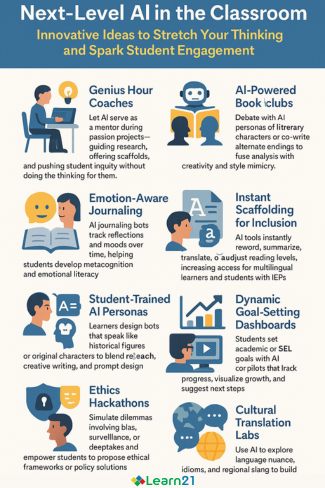
BONUS: Next-Level AI in the Classroom
Innovative Ideas to Stretch Your Thinking and Spark Student Engagement
1. Genius Hour Coaches
Let AI serve as a mentor during passion projects—guiding research, offering scaffolds, and pushing student inquiry without doing the thinking for them.
2. Real-Time Simulations
Use generative AI to create evolving roleplays in history, ethical debates in civics, or responsive science labs that react to student choices.
3. AI-Powered Book Clubs
Debate with AI personas of literary characters or co-write alternate endings to fuse analysis with creativity and style mimicry.
4. Emotion-Aware Journaling
AI journaling bots track reflections and moods over time, helping students develop metacognition and emotional literacy.
5. Instant Scaffolding for Inclusion
AI tools instantly reword, summarize, translate, or adjust reading levels, increasing access for multilingual learners and students with IEPs.
6. Student-Trained AI Personas
Learners design bots that speak like historical figures or original characters to blend research, creative writing, and prompt design.
7. Dynamic Goal-Setting Dashboards
Students set academic or SEL goals with AI co-pilots that track progress, visualize growth, and suggest next steps.
8. Teacher AI Studio Spaces
Educators remix ideas using multimodal AI (text, image, audio, video) to co-create engaging, cross-curricular content.
9. Ethics Hackathons
Simulate dilemmas involving bias, surveillance, or deepfakes and empower students to propose ethical frameworks or policy solutions.
10. Cultural Translation Labs
Use AI to explore language nuance, idioms, and regional slang to build empathy and global competence in world language or social studies classes.
For even more innovative uses of AI in education, check out the 100+ Creative ideas to use AI in education: A collection curated by #creativeHE.
Media Literacy Minute
New Indicator Project Launched to Study Misinformation
Poynter highlights “Indicator,” a new project from misinformation experts Alexios Mantzarlis and Craig Silverman that aims to track and explain how misleading content moves across platforms. The goal is to help both journalists and educators understand where falsehoods originate and how they mutate.
Small Tools, Big Impact in Spotting Misinformation
This article explores how small behavioral nudges like reminders to check the source or pause before sharing can significantly improve accuracy in identifying misinformation. These micro-interventions are easy to incorporate into classrooms and family media habits.
There Are Now More Bots Than Humans Online
According to recent reports, bots now make up over 50% of internet traffic. This shift raises concerns about how misinformation spreads and is amplified by automated systems, thus making media literacy, especially around source evaluation, more important than ever.
Beyond the Office: Creative Ways the Learn21 Team Uses AI in Everyday Life
At Learn21, innovation doesn’t stop when the workday ends. From designing personalized workout plans and chore charts to cooking with what's in the pantry, answering curious kids' questions, and crafting custom bedtime stories, our team is exploring how AI can make daily life smarter, simpler, and more connected. We asked our colleagues how they’re using AI tools in unique, personal ways—and their stories are as inspiring as they are imaginative.
Dylan - I have used ChatGPT when trying to get an answer to a question that requires a specific context. For example, I have searched “Why is cajun seasoning high in sodium if all of its ingredients are low in sodium?”, which has the additional context of me understanding that cajun seasoning doesn’t have high sodium ingredients in it. If I were to just Google the question, I’d have to sift through all the answers that would have simply said “because it has salt in it”. ChatGPT was able to explain that it was simply that most commercial blends include a significant amount of added salt as a primary ingredient.
Danni - Lately, I’ve been putting ChatGPT to work in some creative ways to help keep my life on track. It helped me build a customized 4-week circuit training program using specific exercises I provided, turn a chaotic brain dump into a prioritized family to-do list, and even redecorate my living room by analyzing a photo and suggesting updated paint colors with detailed design feedback. I also used it to develop a balanced summer chore schedule for my kids with clear daily responsibilities. It’s like having a personal assistant, trainer, and interior designer all in one!
Kimberly - I give ChatGPT a list of ingredients from my cabinets and refrigerator and have it create/find recipes for me, so I don’t have to go shopping. My husband uses it as a personal trainer. I also used it to analyze my lease; it made a checklist of everything that needed to be done upon move out (cleaning, reporting to management, turning in keys, etc.).
Kevin - My very curious 5-year-old loves to talk to ChatGPT. It provides him the opportunity to ask all of his “Why” questions (supervised) and dig into the details around bugs, food, plants, history (he’s a big fan of the musical Hamilton) - and we both get to learn together.
Stacy - I became a grandparent for the first time last year. My granddaughter lives in a different state than me. I really wanted to make sure that she knew who I was and felt connected to me when I came and visited her. I started working with ChatGPT to create children's rhymes and stories for her. Each week I tell ChatGPT a detail about her life, like "She just had her first solid food" or "She went to the zoo for the first time." I work with ChatGPT to create a story based on that experience that includes her name. Then I take that and I have it create images. I turn those images into a video and as I narrate and read the story. I record these and upload them each week for her onto YouTube. So each week she gets a new video with my face, my voice, and a story that has pictures and the narrative all about her life. It's turned into quite a fun project and a nice diary of sorts for her as she grows older.
Big Ideas
Paper Planes Take Flight With Precision Engineering
What if your next STEM lesson started with a single sheet of paper? Fold ‘N Fly is a surprisingly deep resource that transforms paper airplane folding into a study in aerodynamics, design, and iteration. With 40+ step-by-step designs ranging from beginner to expert, it's an invitation to explore physics and creativity at once. Big idea: sometimes the simplest tools create the most engaging learning experiences.
Amazon’s New Robot Has a Sense of Touch—And That Changes Everything
Meet Vulcan, Amazon’s latest robot and the first in its fleet to feature a sense of touch. Equipped with tactile sensors and advanced AI, Vulcan can handle delicate tasks that once required human finesse. When machines can “feel,” the boundary between human skill and automation gets blurrier and the implications for labor, logistics, and education are enormous.
When Smart Glasses Get Smarter and Creepier
Meta’s prototype glasses can now identify objects and even remember faces thanks to new AI “super sensing” technology. As The Verge reports, it’s a technical leap with a heavy privacy price tag, especially since facial recognition is banned in many jurisdictions. Just because we can build hyper-aware wearables, should we?
Featured Speaker, Stacy Hawthorne at AETC 2025
We’re excited to announce that Stacy Hawthorne, nationally recognized EdTech leader and Executive Director of the EdTech Leaders Alliance, will be a featured speaker at the Alabama Educational Technology Conference (AETC) on June 18–19, 2025 in Mobile, Alabama!
With a dynamic approach to innovation, practical leadership experience, and a deep passion for empowering educators, Stacy will lead three highly relevant sessions covering artificial intelligence, data privacy, and cybersecurity. If you're a district or school leader, tech coach, or classroom educator ready to navigate the future of educational technology, her sessions are a must-attend.
AETC 2025 Sessions
Beyond the Buzz: Developing an AI Strategy That Works
June 18, 10:15–11:15 AM
Mobile Convention Center / West Ballroom
AI is everywhere in education conversations—but how do school districts move from hype to strategy? This session will help you demystify artificial intelligence and build a district-wide roadmap for responsible adoption. Stacy will share key considerations for AI strategy development, policy creation, educator support, and ethical use—all grounded in real-world examples.
Don't Be Spooked by Student Data Privacy
June 18, 3:15–4:15 PM
Mobile Convention Center / West Ballroom
Turn apprehension into action with this engaging, themed session on student data privacy. Explore risk, governance, and compliance in an educator-friendly format that transforms staff into champions of privacy. Ideal for tech directors, teachers, and administrators looking to build a culture of data safety in their schools.
Guardians of the Grid: Increasing the Cybersecurity Posture in School Districts
June 19, 11:00 AM–12:00 PM
Mobile Convention Center / East Ballroom
Cyber threats are rising in K-12—and schools must respond with resilience. This session unpacks practical frameworks, real-world threat scenarios, and tools like the Cybersecurity Rubric to help schools strengthen their defenses. Learn how to lead your district toward stronger digital safety with confidence.
Whether you're planning your district's AI journey, tackling data privacy concerns, or preparing for cybersecurity challenges, Stacy's sessions will equip you with actionable tools, relatable case studies, and clear next steps.
Expect to walk away inspired, informed, and ready to lead.
Member Discount UDL Conference July 22-23 in Washington DC
This July 22-23, CAST will bring together leading voices in education to explore innovative ways to provide dynamic teaching and learning opportunities via its signature event, the UDL-Con International 2025 in Washington DC at the Capitol Hilton. Don’t miss the opportunity to gain practical experience and join the movement for meaningful change driven by the Universal Design for Learning.
Check out this video recap of the 2024 event. Members are eligible for a 10% discount by registering with this Learn21 Link: https://bit.ly/UDLCON2025Learn21a