
Meet Your New Classroom Library Assistant: A Free Tool from ETLA
If you've ever stood in front of a bookshelf wondering "wait, do I have two copies of this, or did one walk off with a student two years ago?" — this one's for you.
👉Try the Classroom Library Tool now — free for educators
The problem every classroom library eventually runs into
Most classroom libraries grow the same way: a few books from a curriculum kit, a few from a garage sale, a few a student's parent dropped off in May. Within a couple of years, you've got a genuinely great collection — and no real way to answer simple questions like what do I actually own?, what's out with a student right now?, or did that book ever come back?
Sticky-note check-out systems and memory only get you so far. As you're setting up your room for the new year, this is the perfect moment to get ahead of it.
Why keeping track of your library actually matters
It's easy to think of this as a tidiness problem, but it's really a resource problem. A few things every teacher already knows, but that are worth saying out loud:
- Nobody wants to buy the same book twice. When a copy of a favorite title quietly disappears, the usual fix is spending your own money to replace it. Knowing what you have and where it went, means fewer surprise repurchases.
- Hunting down "who has that book" eats into time you don't have. Every minute spent trying to remember who borrowed what is a minute not spent teaching, planning, or actually reading with a kid.
- A library kids can actually find their way into gets used more. Reading research keeps landing on the same point: students read more, and more willingly, when they have easy access to books that match both their interest and their reading level. A library that's organized enough to browse does more good sitting on the shelf than one that's a mystery pile.
In other words, an organized classroom library isn't just easier on you. It's more books, staying in circulation, actually reaching the kids who need them.
What this tool actually does
It's a simple web tool built for exactly this: cataloging what you have, and letting students check books in and out themselves — without you becoming the library desk.
- Add books by scanning the barcode with your phone or webcam. Point, scan, and the title, author, cover image, and a synopsis fill in automatically. Scan a stack of books in a row — everything queues up for you to glance over and approve all at once, instead of one at a time.
- Set up a student self-checkout kiosk. Students type their first name (a last-initial option is available too, for classrooms with repeat first names), find their book, and check it in or out with one tap. Every checkout is timestamped automatically, so no more guessing who has what.
- Keep an eye on things at a glance. Your management view shows what's available, what's checked out, and to whom. It's searchable, filterable, and sortable.
Here's the best part: it's your data
This tool doesn't send your book list to us, to your school, or to any outside database. When you sign in with your own Google account, the app creates a Google Sheet in your own Google Drive — named after your classroom — and everything you add lives there, in a spreadsheet you already know how to use.
That means:
- You own it, completely. It's a normal Google Sheet. Back it up, print it, share it with an aide, or just leave it alone — it's yours.
- You can sort and filter it like any spreadsheet. Want every book currently checked out? Filter the Status column. Curious what's on your "graphic novels" shelf? Sort by collection. Need a quick count for an inventory report? It's all right there, no special software required.
- It's a real history, not just a snapshot. A second tab quietly logs every checkout and return over the whole year, so if a book's status ever seems off, the paper trail is right there.
Getting started is genuinely quick
You don't need any technical setup. Sign in with your Google account, and the tool does the rest — including creating your Sheet automatically the first time. From there, it's just scan-and-go as you shelve your books for the new year.
Why now is the right moment
Before the shelves fill back up and the first-week chaos hits, this is the easiest window all year to get your library actually organized — scan as you unpack boxes, set the kiosk up on day one, and spend the rest of the year knowing exactly what you have and where it is.
See the Classroom Library & Checkout Tool in action in the video below.
Media Literacy Minute
Finland Tries to Protect Children Against Deepfakes, With Russia in Mind
Finland is expanding its decades-old media literacy curriculum to teach children as young as three how to spot AI-generated deepfakes, in response to escalating disinformation pressure from Russia. This Euronews report shows how a national commitment to media literacy, sustained from early childhood through graduation, has helped keep the country resilient against propaganda and misinformation.
UW-River Falls Professor Offers Media Literacy Tips to Spot Fake News
University of Wisconsin-River Falls professor Erik Johnson teaches students to spot AI-generated fake news by fact-checking claims, tracing sources, and noticing when content was pushed to them by an algorithm rather than sought out. This River Falls Journal profile offers concrete classroom strategies educators can adapt to help students build the same habits of healthy skepticism.
Parents Believe Children Should Be Taught Digital Literacy at an Early Age, New Survey Shows
A new survey of 2,000 parents finds that most believe digital literacy education should begin around age four, even though many admit they are figuring out how to teach responsible tech habits as they go. This Talker Research report is a useful reminder for families and educators alike that digital literacy conversations should start well before kids are online unsupervised.
Join Us for the 2026 ETLA Conference!
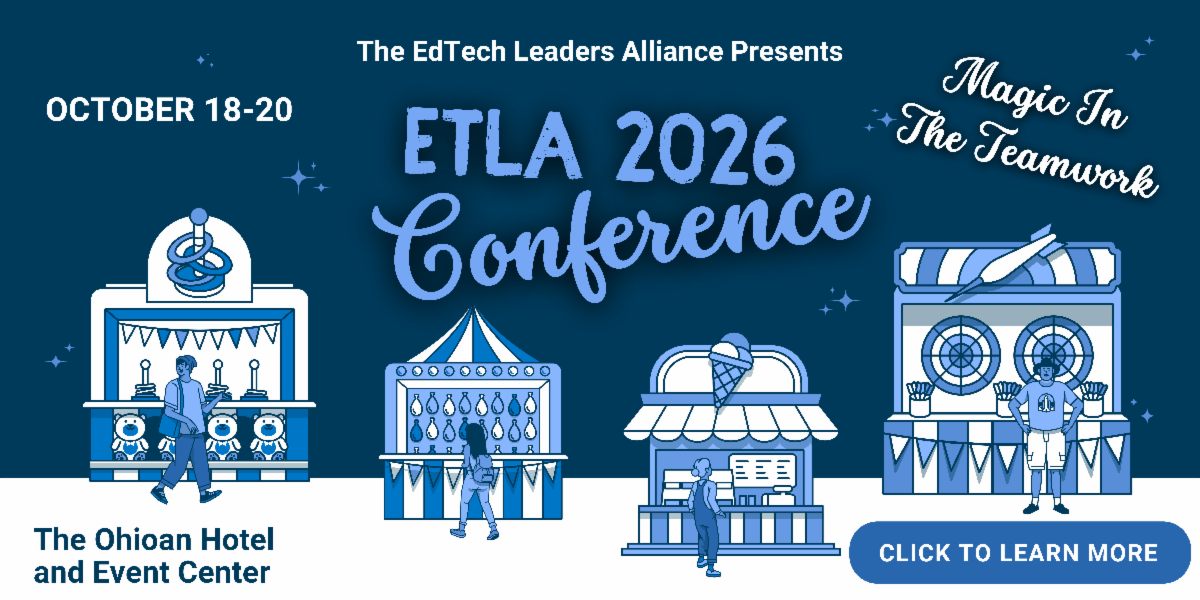
This October, EdTech leaders from across Ohio and the Midwest will gather in Columbus for the 2026 ETLA Conference, running October 18 through 20 at the Ohioan Hotel and Conference Center. This year's theme, Magic in the Teamwork, sets the tone for three days built around collaboration, practical learning, and a some fun along the way.
Get an Early Start with Five Star Technology
Technology directors looking to dive deeper into AI can join a pre-conference workshop hosted by Five Star Technology Solutions on Sunday, October 19th from 10am to 2pm, just ahead of the conference's 3pm kickoff. The session focuses on practical ways to bring AI into district operations, from everyday tools to simple custom applications that solve real problems and cut costs. It is also a chance to swap ideas with peers facing the same challenges. Space is limited to the first 36 people who register.
Keynotes Worth Clearing Your Calendar For
The conference opens Monday morning with keynote speaker Brandon Langer. Tuesday morning brings a second keynote from ETLA's Stacy Hawthorne, joined by a panel of EdTech leaders, digging into how districts can move technology integration from a checkbox to something genuinely purposeful for students and teachers.
A Lineup Built for Every Role
Between the keynotes, attendees will find sessions spanning AI integration, cybersecurity readiness, accessibility, and strategic technology leadership. Whether your focus is classroom-level implementation or district-wide strategy, there is something on the schedule worth your time. The full session lineup is available now at learn21.org/conference.
Beyond the Sessions
The conference schedule also makes room for connection. Sunday afternoon brings a Puttshack social, followed by an evening at the Dueling Guitar Bar. Monday continues with a Vendor Hall Reception and wraps up with the Electric Magic Social, featuring music from ETLA's own DJ Jennah.
Lock in Early Bird Pricing
Register by August 21 to lock in Early Bird pricing. Full details and registration are available at learn21.org/conference.
Big Ideas
A Piece of Homer, Hidden in a Mummy
Archaeologists examining a 1,600-year-old Egyptian mummy found something nobody expected buried in the embalming materials, a fragment of Homer's Iliad. The papyrus had been repurposed as part of the wrapping process: ancient recycling that accidentally preserved a piece of literary history for over a millennium.
The Math That Was Hiding Inside Wordle All Along
Turns out the "best" Wordle strategy isn't guessing the most likely word, it's guessing the word that teaches you the most, even if it's probably wrong. Researchers built a solver that wins 99% of the time by prioritizing information gain over likely answers, using Shannon entropy to identify which guesses reveal the most about the hidden word.
The Deadline That Almost Was — and What Still Applies
Europe just gave classrooms extra runway on AI rules. The high-risk obligations that were originally set to take effect on August 2, 2026, covering AI systems used in education for admissions, learning-outcome evaluation, student placement, and exam or behavior monitoring, have been pushed back, with the new compliance date now set for December 2, 2027.
But "delayed" doesn't mean "dismissed." The postponement only delays enforcement — the underlying obligations around transparency, oversight, and responsible AI use in assessment haven't changed, and institutions are still expected to work toward meeting them well before the new deadline. In other words: the requirement was never really hiding, it's just been given a later due date. Schools and universities that treat this as a reason to relax may find themselves scrambling again in 2027.