Boo! Your Kids' Data Might Be Trick-or-Treating Without You
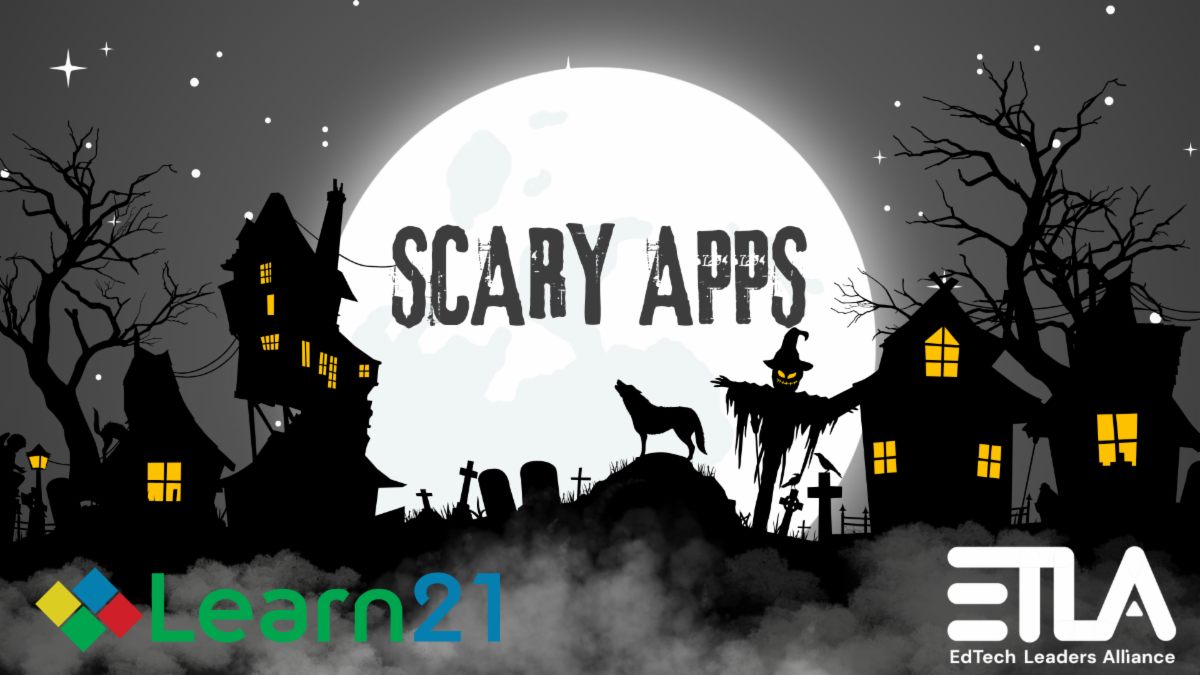
It's that time of year again: pumpkin spice is back, decorative skeletons are climbing out of front lawns, and somewhere in a K-12 classroom, a teacher is signing a student up for an app called something like "SparklePals" without reading a single word of its privacy policy. Truly, the scariest costume this Halloween isn't a ghost or a goblin; it's a 40-page terms-of-service document nobody has ever opened.
That's where Scary Apps comes in.
Every October Learn21 and the EdTech Leaders Alliance hosts what might be the only Halloween tradition built entirely around fine print. Instead of counting down to Halloween with candy, Learn 21 and ETLA count down with a daily reveal of an app whose privacy practices deserve a good, long shudder. One app, every day, all October long – each one a little treat of "wait, they do what with student data?"
How an app earns its cape and fangs
Not every app on the list is evil. Most aren't mustache-twirling villains; they're just companies that do not understand the laws of K-12 privacy, or maybe never quite got around to the boring, unglamorous work of student data privacy. The apps that land on the Scary Apps list tend to share a few telltale traits:
- They won't sign a data privacy agreement (DPA) with schools, the document that spells out what a vendor can and can't do with student information. No signature, no accountability, and that's Scary Apps Rule Number One.
- They share personally identifiable information (PII), like names, emails, birthdates, sometimes more - with third parties who have nothing to do with your kid's algebra homework.
- They allow targeted advertising aimed at users who are, let's remember, minors.
- They quietly require users to be 18+ in their terms of use, even while marketing themselves directly to elementary and middle schoolers; a legal escape hatch dressed up as fine print.
None of that is funny. But making it visible, one jack-o'-lantern graphic at a time, turns "read this 40-page privacy policy" into something people actually pay attention to.
A brief history of frights
The tradition started a couple of years back, when Learn21 began asking educators to nominate apps whose privacy policies gave them the creeps, then dug into each one personally to see whether the fright was justified. What began as a modest social media project quickly caught on as one of the more inventive ways anyone has found to make data privacy compliance feel less like a compliance training and more like a scavenger hunt.
Since then, the list has grown into a genuine October institution, working alongside members of the EdTech industry to bring real rigor to the reviews. Past years have called out a wide-ranging cast of characters, including familiar classroom names, popular games, productivity tools, and social apps, proving that "scary" isn't reserved for obscure fly-by-night software. Sometimes it's the app everyone already has installed.
The good news: monsters can reform
Every year, some of the apps that once earned their spot on the list have updated their privacy policies, signed a DPA, or otherwise cleaned up their act.
That's the whole point of Scary Apps. The goal has never been to scare vendors for sport; it was to scare (and educate!) them into doing better. And it's working. A public callout is a surprisingly effective motivator when a company realizes thousands of district tech directors are watching an October countdown with their name potentially on it. Every updated privacy policy is proof that a little Halloween shade, applied consistently, can move the needle on something as unglamorous and important as student data protection.
This year's lineup
This October's Scary Apps list will start dropping daily on October 1st, and it's a genuinely eclectic haunted house: everything from design tools and drawing software to social platforms, AI chatbots, and yes, a few apps you probably use yourself before 8 a.m. Some are perennial classroom favorites; others are apps that snuck onto school Chromebooks the way candy sneaks into a trick-or-treat bag nobody remembers buying.
Whether you're a teacher, a tech director, or a parent who just wants to know what's really happening to your child's data, it's worth following along. The goal isn't to make you feel guilty about every app your school uses. It's to help you start asking the right questions.
How to join in
Follow Learn 21 and ETLA's social channels for the daily reveal all October long, and don't be shy about nominating an app of your own next year if something's been keeping you up at night. And if you spot a familiar name on this year's list? Don't panic — apps get a chance to fix things, and plenty have. The scariest part of Scary Apps was never meant to be the apps themselves. It's the reminder that somebody has to actually read the privacy policy, and this year, Learn21 and ETLA already did it for you.
Media Literacy Minute

Students Tackle Declining Trust in News
At Northglenn High School near Denver, ninth graders took on a Problem-Based Learning challenge: helping people identify credible news sources as public trust in media declines. One team proposed a “News-trition Label” that would show an article’s ingredients, like aggregation or unverified facts, much like a food label. This Editor & Publisher piece shows how giving students a real problem to solve turns media literacy into something they actively participate in, not just study.
Is There a Right Age for AI in Education?
With UNESCO recommending no generative AI use under age 13 and some states adding their own age limits, LSE’s Sonia Livingstone argues that developmental science offers no single “right age,” and notes that 73% of U.S. teens have never talked with a teacher about how AI works. This Media@LSE commentary makes the case for starting AI literacy early, while being far more cautious about using AI tools to teach core subjects.
Media Literacy Helps People Spot Political Deepfakes
In a study of more than 1,100 adults in the U.K., Slovenia, and Italy, realistic political deepfakes were harder to detect and more likely to be liked, especially when viewers already felt positively about the person shown. This Nature Portfolio study found that higher media literacy improved detection and reduced willingness to share fakes, a reminder that teaching students to check their emotional reactions matters as much as spotting technical flaws.
Be in the Room: PrivacyForward Brings K-12 Privacy Leaders Together
As schools rely more on digital tools, from learning management systems to AI-powered classroom apps, protecting student data has never mattered more. PrivacyForward is stepping into that gap with a clear mission: give the people responsible for safeguarding student information the training, tools, and community they need to do it well.
Hosted by the EdTech Leaders Alliance (ETLA) and the Tennessee Educational Technology Association (TETA), Privacy Forward's flagship event is the inaugural National Student Data Privacy Conference, November 30 to December 1, 2026, in Chattanooga, Tennessee. It is the premier national conference dedicated exclusively to K-12 student data privacy, bringing together district leaders, privacy professionals, legal experts, EdTech executives, and vendors.
Why Now
Student data privacy is too often treated as an annual compliance checkbox. Privacy Forward is built on a different premise: privacy should be a living practice, not a static policy. That shapes the conference design, built around hands-on training with real tools and data privacy agreement (DPA) frameworks, a resource kit made for immediate district use, and a national peer community.
Three Ways to Take Part
- School and district leaders: Two days of workshops, deployable DPA frameworks, and a peer network that lasts past the event.
- Vendor Certification Training: A half-day pre-conference session covering FERPA, governance, and vendor management, ending in a Student Data Privacy Certification. This training is a separate event and requires its own registration. Conference registration does not include it. Register today.
- Exhibitors and sponsors: Direct access to K-12 privacy decision-makers, plus founding-partner visibility at an inaugural event.
A Coalition, Not Just a Conference
Privacy Forward is proudly endorsed by the Learning Technology Center (LTC), MOREnet, NYSCATE, RIC One, the Student Data Privacy Consortium (powered by A4L), and the TEC Student Data Privacy Alliance, with more endorsements to be announced. No single district, state, or vendor can solve student data privacy alone. This event brings the whole ecosystem into one room.
Plan Your Trip
A room block is held at the Chattanooga Marriott Downtown at $155 per night. Book by Sunday, November 1, 2026, or until the block sells out.
The conversation is happening. Be in the room.
Space is limited. Register now and learn more at privacyforward.org..
Big Ideas: Amateur Hour, Professional Results
Turns out you don't need a PhD to change science. You just need to be looking at the right thing at the wrong time.
The Crater Hiding in a Camping Trip
In 2024, Joël Lapointe was planning a camping trip to Quebec's remote Côte-Nord region when a circular feature near Lake Marsal caught his eye on online satellite imagery, so he emailed experts to ask if it might be an impact crater. It was: a 2025 expedition found shatter cones on day two, and rock samples date the 25-kilometer structure to roughly 390 million years ago. Earth has only about 200 confirmed impact structures, with hundreds more likely still hiding, so let people loose on satellite maps to hunt for suspicious circles and then debate what evidence would actually prove one.
The $100 Box That Catches Space Particles
CosmicWatch is a handheld muon detector about the size of a pack of animal crackers, with electronics that cost only about $100, first built by Spencer Axani in 2017 as an MIT grad student. What started as a student physics project now shows up in major experiments and balloon missions, and might eventually fly on spacecraft. Better still, it's designed so a novice student can build their first detector in about four hours, which makes it a ready-made STEM project: assemble one, then have the class design an experiment to test whether muon counts change by floor, time of day, or weather.
The Teacher Who Found T. rex's Footsteps
Kent Hups, a high school science teacher from Northglenn, Colorado, was volunteering on a North Dakota dig when he spotted what became the first known trackway left by a T. rex. Before this, only two isolated adult T. rex tracks had ever been found, but the team uncovered a roughly 23-foot trackway with four footprints, each around three feet long. It's a perfect math-meets-paleontology lesson: have students measure their own stride length versus foot size, then use the same ratio to estimate how fast a T. rex was strolling.
Three discoveries, zero job titles that match. A camper, a grad student tinkering, and a teacher on his summer break all spotted what the professionals hadn't, then did the most underrated thing in science: they asked someone. As Lapointe put it, the lesson is to trust an observation even when it's outside your expertise. Or, as Hups said, amazing stuff is always out there, but you have to go looking. The gatekeepers of discovery, it turns out, are mostly just people who haven't checked Google Maps yet.