
Guess Who's Coming to Dinner: The Subprocessor Problem
You invited one guest. You checked their references, read their bio, maybe even signed a nice agreement about table manners. Then the doorbell rings, and they've brought eight friends you've never met. One of them is already in the fridge.
Welcome to Thanksgiving in EdTech, where the vendor you vetted is rarely the only one eating off your plate.
The Guest List You Never Saw
When a district purchases an application, it’s often not just agreeing to do business with just that company. It's agreeing to work with that company's hosting provider, analytics service, email platform, crash-reporting tool, customer support desk, and whatever AI model got bolted on last spring. In privacy-speak, these are subprocessors. In Thanksgiving-speak, they're the cousins nobody RSVP'd for.
This isn't a hypothetical. In its 2022 K-12 safety benchmark, Internet Safety Labs tested apps used across all 50 states and found that 96% of them shared children's personal information with third parties. Some of that is expected. Hosting, email delivery, and customer support often require outside vendors, and student privacy laws allow it when the vendor is bound by the same protections. But 78% went to advertising and data analytics entities, usually without schools or families knowing.
Ninety-six percent. That's not a few rude cousins. That's the whole extended family, plus the neighbors.
Why the Seating Chart Matters
Here's the uncomfortable part: your data privacy agreement protects you only so far. A vendor can have a spotless privacy policy and a signed Data Privacy Agreement (DPA), and still route student data through a dozen services you've never heard of.
Each subprocessor is another door. The DPA requires the original vendor to make sure those doors are held to the same standard, or higher, through its own agreements. That’s an important protection, but the district can’t see those agreements or test those locks. Each company has its own security practices, breach history, and definition of “deleted.” When something goes wrong three links down the chain, the headline still has your district’s name in it.
The ISL findings also showed that most schools' vetting isn't catching this. A 2025 COSN survey found that while 77% of district technology leaders said their districts had a process for vetting the privacy and security of new technologies, only 55% said teachers knew about it and used it.
Checking the Guest List Before You Carve
You don't need to cancel dinner. You need a better guest list. A few questions worth asking every vendor, every time:
- Who are your subprocessors, by name? Not "trusted partners." Names. If they can't produce a list, that's your answer.
- What does each one receive? Hosting your encrypted files is different from receiving student names for "product improvement."
- Are your subprocessors bound by the same terms you agreed to? Your DPA should require that obligations flow down the chain, not stop at the front door.
- How will you tell us when the list changes? Vendors add services all the time. Notice should be required, not optional.
- Where does the AI fit? If student data touches a third-party model, you want to know which one, and whether it's used for training.
National vetting rubrics and Data Privacy Agreement templates already push in this direction by requiring providers to hold subprocessors to the same standards. The agreement is a floor, though. Reading the actual list is still on you.
Grace Before the Meal
The good news is that this is a fixable problem, and nobody has to fix it all at once. Start with one question at your next vendor renewal: who else is at the table? Every district that asks makes it a little more normal for vendors to answer, and the more normal it becomes, the more likely it is to show up in agreements by default.
The goal isn’t a perfect guest list. It’s a better one each year, and every question you ask a vendor gets you closer. So this Thanksgiving, be grateful for the vendors who make that easy, and set one more place card than you did last time.
Media Literacy Minute
15-Minute Lesson Plan: Spotting Fake Health Influencers
The New York Times found hundreds of AI-generated doctors, healers, and wellness influencers on social media pushing supplements with misleading health claims, many aimed at older women. This New York Times Learning Network lesson pairs a five-minute video with discussion questions that help students spot the tells of AI fakes and decide whom to trust online, making it an easy 15-minute classroom activity or dinner-table conversation.
UNESCO Launches a Media Literacy Curriculum for the Age of AI
UNESCO’s new guide, AI Answers. You Decide., helps educators teach students to question how AI shapes the information they see, from algorithm-driven feeds to convincing AI-generated text, images, and video. This UNESCO announcement explains how the resource builds on UNESCO’s widely used Think Critically, Click Wisely! curriculum and focuses on critical thinking rather than specific tools, so it stays useful in any classroom as the technology changes.
Students Are Using AI, but Few Are Taught How
A new Hanover Research survey of K-12 parents and staff finds that more than half say students use AI for schoolwork, but most say students are told when they can use it rather than how to use it well, and only 37% of staff feel very comfortable showing them. This EdTech Magazine article shares the report’s recommendations, including a “living” districtwide AI framework and ongoing AI training for teachers and students, which are useful starting points for any school building AI literacy.
Gobble Lab: A Thanksgiving Brain Break
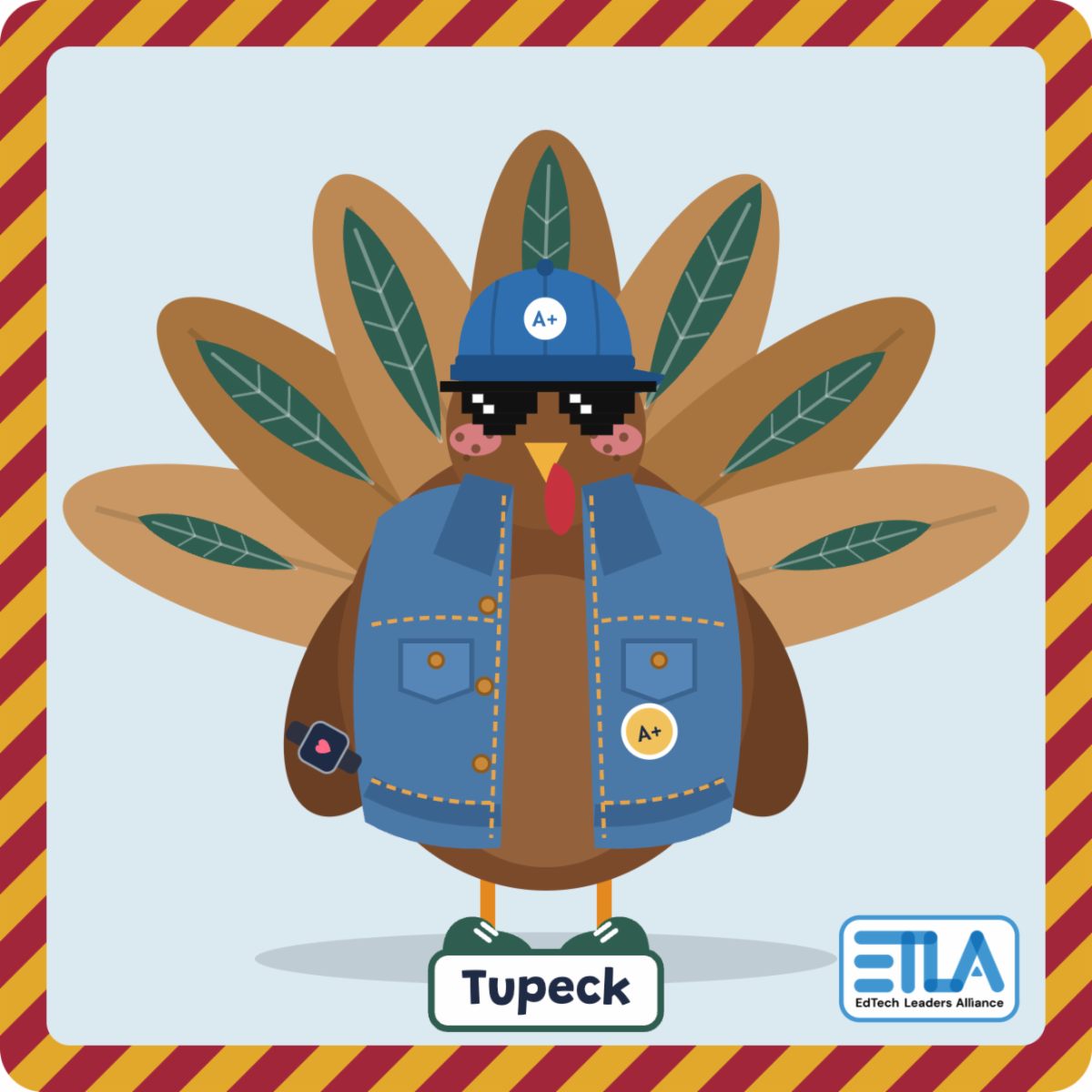
Need a five-minute brain break before the long weekend? Meet Gobble Lab, a free set of Thanksgiving activities from EdTech Leaders Alliance. It's part of ETLA's suite of school tools.
It runs right in a web browser, with nothing to download and no accounts to set up. Pull it up on the projector at the start of a staff meeting, share it during an advisory period, or hand it to students who finish early. Every activity is quick, a little silly, and sneaks in some learning about technology along the way.
What's on The Menu
Gobble Lab serves up four activities, each on its own tab.
Silly stories. Pick one of 12 Thanksgiving stories and fill in the blanks without seeing the story first. Then reveal it and find out what you made. Plots include a Wi-Fi outage at dinner, a smartboard that eats the pumpkin pie, and a turkey who joins the robotics team. Each blank comes with a quick grammar hint, and the finished story can be read aloud.
Dress the turkey. Start with a plain turkey and drag on hats, glasses, feathers, and outfits, Mr. Potato Head style. The closet includes a VR headset, a teacher cardigan, a jean jacket, a staff badge, a laptop, and a robot buddy. Give your turkey a name, then download it as a picture to share.
Coding maze. Help a hungry turkey reach the pie by building a short program with move, turn, and repeat blocks. Six levels move from first steps to "The big feast." It's a gentle introduction to sequencing, loops, and debugging.
Real or AI? Twelve Thanksgiving "facts" appear one at a time. Some are true, and some were made up the way an AI chatbot sometimes invents details. Players guess, then get the real story and a tip for checking claims like it.
Show Us Your Turkey!
We want to see what your staff and students create. Download your dressed-up turkey and share it on social media, and be sure to tag the EdTech Leaders Alliance when you post.
Open Gobble Lab and take a well-earned break. Happy Thanksgiving from all of us at ETLA!
Big Ideas: Rewriting the Textbook
If you tell a teacher a textbook is wrong, they’ll sigh, get out a red pen, and keep going. This week science gave them three more corrections to make.
Neanderthals: Flat-Footed, and Better For It
Neanderthal feet have been treated as clumsy versions of ours, and that turns out to be wrong. Researchers made 3D scans of fossil heel bones and found that Neanderthals had a flat foot and used this posture to maximize stability and reduce impact stress under heavy loads. Our heels haven’t held up as well: the individuals who have lived in the last centuries have heels that are much weaker, due to a sedentary lifestyle and the habitual use of rigid and closed footwear. I’ve had flat feet all my life, and I’ve finally found my people. Unfortunately, they went extinct 40,000 years ago. Sounds about right.
Stonehenge’s Altar Stone Loses Its Home Again
In 2024, scientists said they had finally traced Stonehenge’s six-ton Altar Stone to northeast Scotland, more than 400 miles away. This month, a new study compared the Altar Stone’s detailed geological signature with field samples gathered across the alleged origin site in Scotland’s Orcadian Basin, and the samples didn’t match. So the case is open again, along with every “how did they haul it from Scotland?” theory built on the old answer. Science solved it in 2025 and un-solved it in 2026, which is still faster than my Internet provider’s customer service.
A New Kind of Magnetism, Ninety Years Later
Since the 1930s, physics recognized two types of magnetism: ferromagnetism, the kind holding art to your fridge, and antiferromagnetism, where spins cancel each other out. A SLAC-led team has now delivered conclusive experimental proof of a third magnetic phase called altermagnetism. It shows a spiral-staircase twist in a material called manganese telluride. Altermagnets aren’t easily scrambled by stray magnetic fields, which makes them promising for faster and tougher memory chips and quantum tech. A spiral twist, mysterious attraction, and nobody can quite explain it: either altermagnetism or a 1987 Patrick Swayze movie full of animal magnetism.
Keep the red pen handy. Science is never finished, and neither is your textbook.