
Getting caught up with what we know instead of what we need to know
As educators, we're not just teachers, we are also perpetual students. We're still humans totally capable of getting stuck in a rut or turning our classrooms into echo chambers. We can wind up with our own version of Groundhog Day, recycling the same ideas, methods, and perspectives.
Recognizing our echo chamber can be pretty easy. To break the cycle I have to check in with myself. Have I done anything new lately? Do I only read articles that I agree with? How long has it been since I've been uncomfortable?
Figuring out what we need to know
Where can we start if we realize we're in a rut and we want to branch out? Start by making yourself uncomfortable. Ditch the textbook for a day. Try a new tech tool (check out the privacy policy first). Actively seek out opinions and methods that challenge your own. You know that one teacher that you disagree with on every aspect of teaching? Talk to them and learn their perspective. Pushing yourself in these ways helps foster a culture of continuous learning.
Even as adults our learning journey hasn't ended. By keeping our mind limber and exercising it in new ways, we can become more versatile and effective teachers. It’s not just about teaching, it’s about growing and learning.
Tips and Tricks
Let's say you've been working in Google Docs or Microsoft Word and you have some specific formatting of text that you've worked really hard to create. After adding another section to your document, you realize that you need to format the new section like the previous section. Well, Docs and Word have you covered. Both of them can copy the format of text, and then paste that format onto new text.
To get started you will highlight the text with the formatting you want to copy. Next, click on the Format Painter in Word or Paint Format tool in Google Docs:
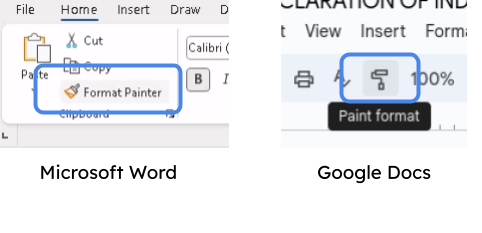
Finally, highlight the text you wish to apply the format to. After you finish highlighting, the formatting will be applied. If you need to format multiple sections, you can double-click the Format Painter or Paint Format and it will stay selected so you can highlight and change formatting multiple times.
The rise of ChatGPT brings new ways for students to cheat. Our response to cheating has to have a lot more nuance, especially for our middle school students. It seems like the AI detectors don't work. One reason the detectors are failing is that neurodivergent writers may show up as AI generated. Tread carefully into this brave new world. It's not easy, and it's only going to get harder.
Google's Jamboard is going away and there are several alternatives being promoted. One promising example is the whiteboard in Canva. The other examples we hear being tossed around are ones that have landed on Scary Apps due to their privacy policies. Make sure you're reading those thoroughly before introducing any new app to students.
Learn21 Update
Hitting the Conference Circuit: Key Takeaways for Improving Student Outcomes
As a non-profit organization focused on helping schools leverage technology to improve K-12 education, our team makes it a priority to attend state and regional EdTech conferences to stay on top of the latest innovations and best practices. After crisscrossing the country these past few months, we wanted to share some major takeaways that can drive better student outcomes in this quickly-evolving realm.
At the OKSTE conference, we learned about the state’s promising new Computer Science for All initiative focused on computational thinking and coding skills. By starting CS education as early as kindergarten and using engaging programs like Code.org, Computer Science for All aims to prepare students for our increasingly tech-driven economy while empowering diverse groups traditionally underrepresented in the field.
The NYSCATE conference in Rochester highlighted Syracuse City School District’s innovative teacher residency program focused on tech integration across core subjects. Their extended clinical training model goes beyond one-off professional development to ensure educators leverage technology meaningfully and effectively in daily instruction. Students who complete the program become tech integration leaders within their schools.
Our most recent stop was CITE in California, where we were impressed by schools looking to adopt personalized learning platforms. These schools are looking to use adaptive software, data analytics, and one-on-one mentoring, to make significant gains in graduation rates and test scores. The key is providing customized pathways tailored to each student’s needs and talents.
Of course, our favorite conference is our own Ohio CoSN - ISTE Conference. Our conference is held annually each fall and is a great opportunity for educators and technologists to envision the future of education. Next year’s conference will be held October 20 - 22, 2024 under the new Edtech Leaders Alliance going forward. Our name change symbolizes a collaborative approach to education where technology is curriculum and curriculum is technology. We’ve also removed the state designation from the title as we believe that all schools, including those in Ohio where we have our roots, are better served when we collaborate more broadly.
Of course, generative AI was a key topic at each conference. It’s everywhere! We even did a few sessions of our own on the topic. You can check out all of our resources from our presentation “AI: They Built It, Now What?” here. We have four ISTE Certified Educators, three Certified Cybersecurity Rubric Evaluators (CCRE), and two CoSN Certified Technology Leaders (CETL) on our team, making us your dream team when it comes to support with integrating generative AI while enhancing student data privacy in your school.
While every state faces unique challenges, each of these conferences offered ideas, ethical frameworks, and professional development strategies that could benefit students everywhere. We look forward to diving deeper into these approaches and working with our school partners to implement similar programs focused on personalized pathways, computational thinking, embedded edtech training, digital literacy, and digital citizenship. Only through conferences like these can we spotlight successes, share ideas across state lines, and collectively advance the national conversation around empowering students through technology. There are so many inspiring innovations out there, but more work lies ahead to ensure digital equity. Let the discussion continue!
Extra Credit
Does it seem like your heart skips a beat when encountering grammatical errors? Well, it's not a feeling. Researchers have found that hearing grammatical errors can affect your heart rate variability.
AI isn't going anywhere, so how should we view it in our work and personal lives? This is a fascinating and in-depth look at viewing AI as the helper it can be.
What is professionalism? Although the article is for programmers, I related to a few points the author made. He relays the straw man argument that "There’s a misconception that professionalism is the diametrical opposite of ‘fun’ — so as long as you’re not fun, you’re professional. No jokes, no sparkles, no pride in your job." If that's what's required to be a professional, then count me out. Luckily, the author doesn't believe this either.
Bytes and Insights is written by Eduk8me’s Ryan Collins who writes about education and educational technology. He’s also the Director of Technology for Kenton City Schools in Ohio. Sign up for his Of Bits and Bytes newsletter at https://eduk8.me.