
Bridging the Gap: Aligning Teacher Licensure with Future-Ready Student Outcomes
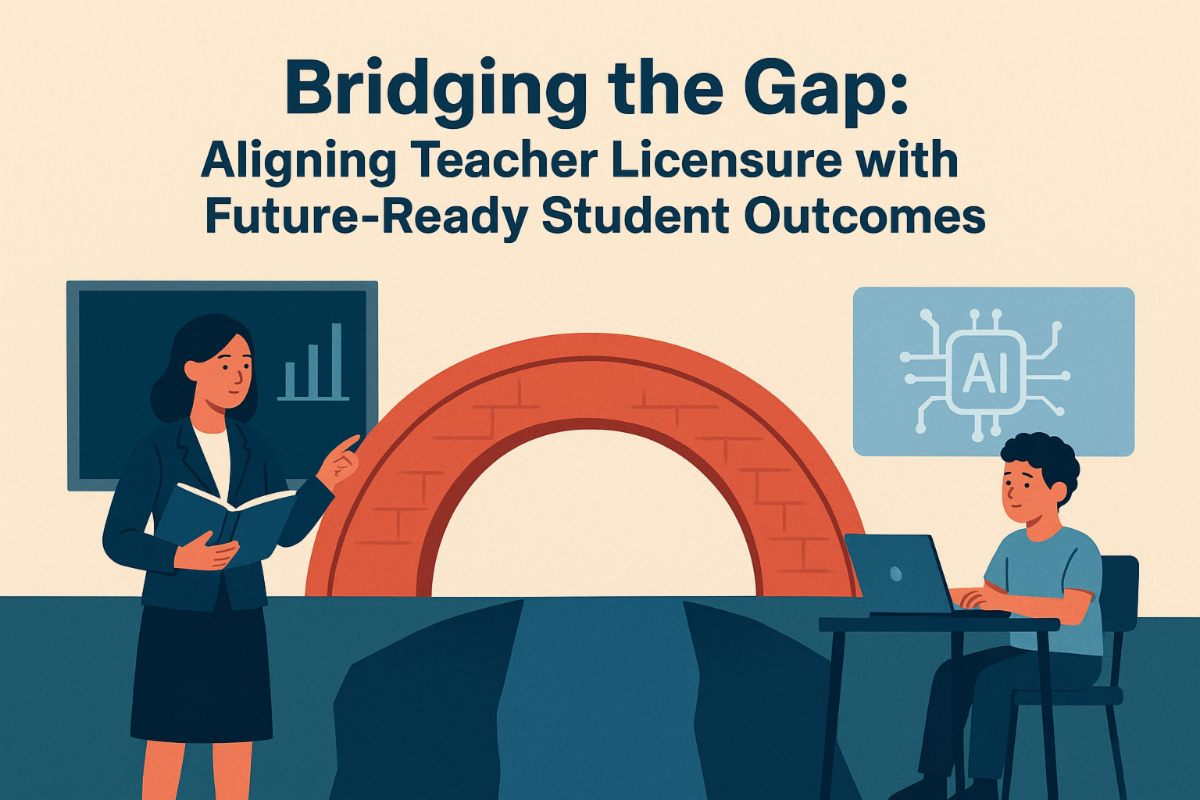
What if the very system designed to prepare teachers is misaligned with the skills students need to succeed after high school?
That’s the fundamental disconnect we must confront as we prepare students for a future driven by artificial intelligence, rapid innovation, and constant transformation. While this challenge spans all 50 states, let’s take a closer look at Texas—because that’s where I live, and it offers a clear lens into a national problem.
The Employer Reality: Skills Wanted
In May 2025, Inc. magazine published an article titled “CEOs of Microsoft, Salesforce, and Hundreds More Push for AI Training in High School,” detailing a growing demand among tech leaders for high school graduates to be proficient in artificial intelligence, data literacy, and advanced digital tools. This request, backed by executives from companies like Microsoft, Intel, and Salesforce, highlights a major shift: employers are prioritizing adaptability, collaboration, and AI fluency over traditional content knowledge.
That call mirrors the findings of the World Economic Forum’s Future of Jobs Report 2025, which identifies the following skills as most in demand through 2030:
- Analytical thinking
- Creative thinking
- Technological literacy
- Curiosity and lifelong learning
- Resilience, flexibility, and agility
These are not optional add-ons. They are foundational for success in a world where automation and generative AI are reshaping how work gets done.
The Graduate Reality: Testing and Compliance
Now consider what Texas requires of its high school graduates. Students must complete the Foundation High School Program with at least 22 credits and pass five end-of-course (EOC) assessments: Algebra I, Biology, English I, English II, and U.S. History.
While endorsements such as STEM and Business & Industry are available, they do not necessarily provide structured opportunities to build future-ready skills like innovation, AI fluency, or systems thinking. Graduation remains anchored in standardized assessments, not in demonstrations of creativity, collaboration, or real-world problem solving.
In 2023, over 11% of Houston ISD students received diplomas through Individual Graduation Committees (IGCs), a process created for students who failed one or two of the state’s five required tests but demonstrated mastery through alternative means (Good Reason Houston). That means nearly 1 in 8 graduates met all classroom requirements but stumbled on the high-stakes assessments.
The Teacher Reality: Preparation for the Past
Who is preparing these students? Teachers who themselves are often prepared in programs that don’t prioritize the skills today's workforce demands.
In Texas, to become a classroom teacher, candidates must meet initial certification requirements, which include:
- A bachelor's degree
- Completion of an approved Educator Preparation Program (EPP)
- Passage of certification exams (such as TExES)
- Fingerprinting and background checks
Let’s look at two specific examples:
1. UTeach at the University of Texas offers coursework focused on field experiences and STEM instruction but does not explicitly include training on AI, digital ethics, or the future of work.
2. Texas A&M’s Bachelor of Science in Education (Math/Science for Middle Grades) emphasizes foundational content knowledge and pedagogy, but again lacks a focus on workforce-aligned competencies like systems thinking or digital fluency.
Texas is not alone here. Teacher prep programs across the U.S. remain bound by legacy requirements that favor theoretical knowledge and content mastery over flexibility, innovation, and real-time tech adaptation.
The Disconnect: Who’s Preparing Whom for What?
This leaves us with a troubling question: Who is preparing students for the world they’re about to enter?
We ask teachers, many trained in systems untouched by recent technological shifts, to guide students through graduation paths still built around 20th-century expectations. Then we hope that somehow, this will prepare those students for 21st-century workplaces that demand entirely different competencies.
And yet, the workforce has evolved. According to the Future of Jobs Report 2025, 44% of workers' core skills are expected to change in the next five years, and over 60% of employers say they will prioritize hiring based on skills over degrees.
Bridging the Gap
It’s time to realign:
- Teacher licensure should evolve to include training in AI integration, digital literacy, and project-based learning that fosters critical thinking.
- Graduation requirements should shift from compliance-based testing toward flexible demonstrations of future-ready competencies.
- Teacher preparation programs must modernize, offering real-world connections to the skills students actually need after high school.
Imagine if teacher candidates were assessed not just on their content knowledge but also on their ability to facilitate real-world innovation challenges. Imagine if high school students were required to lead collaborative projects that address global issues using AI tools and systems thinking frameworks.
We don’t have to imagine it forever. We just have to build the bridge between the old requirements and the new realities.
And in Texas, as in every other state, that work can start now.
Media Literacy Minute
Don’t just Google it
In this Tech Policy Press article, researchers and journalists warn that search engines and social platforms are increasingly acting as information gatekeepers. Search personalization, SEO strategies, paid results, and AI-generated summaries can limit access to diverse perspectives. Educators have an opportunity to help students not only use search tools effectively but also learn how to bypass algorithmic filters to find richer, more varied sources.
Print still leads for preschool literacy
A Michigan State University study found that preschoolers who engage in print-based activities like writing, letter recognition, and shared reading outperform peers who primarily use digital literacy games. This holds true across various groups, including children with speech or language challenges, underscoring that engaging, tactile learning still plays a powerful role in early literacy development.
Curiosity as a first line of defense
In this podcast conversation with Lynn Borton, News Literacy Project’s Dan Evon discusses RumorGuard’s approach to tackling misinformation by leaning into curiosity. He emphasizes slowing down, questioning sources, and developing what he calls the “Huh Muscle”—an instinct to pause and verify before accepting or sharing information.
Preparing Students for a World of Uncertainty
The New Question for Schools
Artificial Intelligence (AI) is here to stay. In education, the conversation often splits into two camps: those who fear AI will erode critical thinking and academic integrity, and those who see it as a powerful partner for learning. The truth lies somewhere in between. AI’s potential is enormous, but it comes with real risks that schools must address head-on.
The Benefits of AI: Amplifying Learning and Teaching
When used thoughtfully, AI doesn’t replace human thinking—it magnifies it. It frees educators to focus on deeper learning and empowers students to explore, create, and problem-solve.
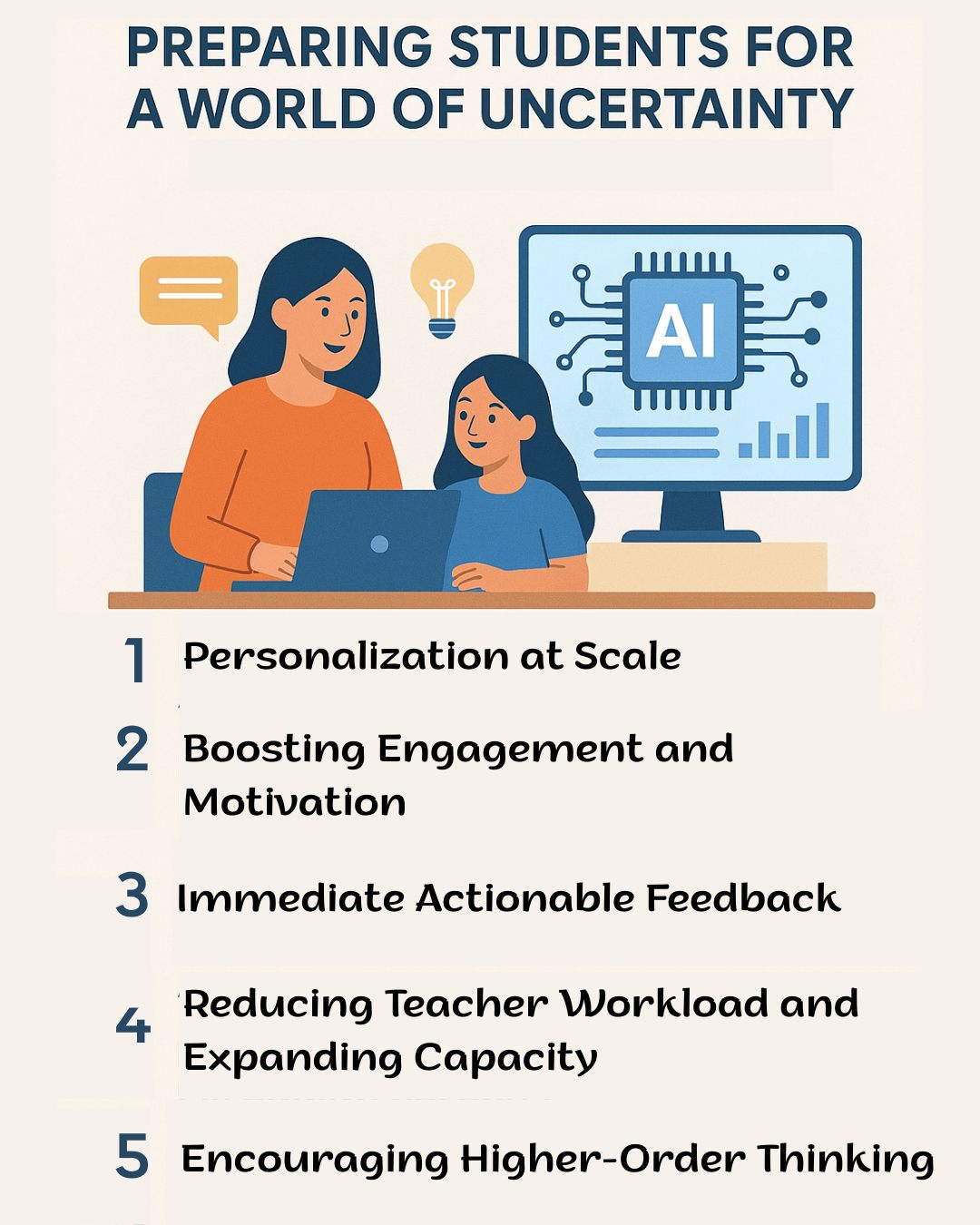
1. Personalization at Scale
One of AI’s greatest strengths is its ability to adapt content for individual learners in real time. In a 2025 meta-analysis of 31 studies, Generative AI tools had the largest positive effects in K–12 settings, particularly in flipped classrooms and short-to-medium-term interventions. This flexibility enables teachers to tailor materials to different reading levels, learning styles, and linguistic needs, whether through simplifying complex texts or providing enrichment for advanced learners.
2. Boosting Engagement and Motivation
AI-supported lessons can spark student curiosity and sustain attention. In gamified physics classes, ChatGPT-powered activities improved both student performance and motivation. In arts education, generative tools encouraged experimentation with style and composition, helping students feel more confident in their creative abilities. These examples show that when AI is integrated into meaningful, hands-on learning, it can increase participation and ownership.
3. Immediate, Actionable Feedback
AI can give students real-time guidance, allowing them to refine their work without waiting days for feedback. This supports formative assessment practices that keep learning on track. For teachers, it means more time for rich, in-person discussions rather than repetitive marking. As Amir Taron Ayres, writing for Edutopia, points out, when teachers treat AI as a “thought partner” to brainstorm, scaffold, or refine instructional materials, the process becomes more responsive and collaborative which leads to more engaged classrooms.
4. Reducing Teacher Workload, Expanding Capacity
From automating basic administrative tasks to generating draft lesson plans, AI can save teachers hours each week. This reclaimed time can be reinvested into relationship-building, small-group instruction, or one-on-one conferencing. Digital Promise emphasizes that this efficiency, coupled with intentional teacher exploration, can free up mental space for deeper instructional design and creativity.
5. Encouraging Higher-Order Thinking (With the Right Scaffolding)
Far from undermining critical thinking, AI can be used to strengthen it. Holmes et al. (2022) highlight that with proper professional development, teachers can design activities where students critique AI outputs, compare them to their own ideas, and refine their arguments. This shifts AI from an answer machine into a provocation for analysis, synthesis, and evaluation—the very skills students need for a world of uncertainty.
Risks Worth Addressing
While AI offers promising benefits, ignoring its risks could undermine the very skills schools aim to nurture. These challenges are not reasons to ban AI, but signals that careful, deliberate planning is essential.
1. The Quiet Erosion of Critical Thinking
When students lean too heavily on AI to brainstorm, structure, or even fully write their work, the cognitive heavy lifting shifts from their minds to the machine. A recent study out of MIT found that students who relied solely on large language models (LLMs) for essay writing exhibited weaker brain connectivity, especially in the frontal and parietal regions tied to reasoning and problem-solving, compared to peers who wrote without assistance. This “cognitive debt” left them less engaged and less able to recall their own work. The takeaway? Without intentional guardrails, AI can foster passive consumption rather than active creation.
2. Overdependence and Loss of Authorship
In the same study, LLM users reported the lowest sense of ownership over their essays, and in some cases struggled to quote or explain their own arguments. This detachment from one’s own work poses long-term risks to academic integrity and self-efficacy. If students stop seeing themselves as the authors of their ideas, the erosion of identity as a learner can follow.
3. Widening Equity Gaps
AI literacy is becoming as essential as reading and math, but not all students have equal access. Those in well-funded districts may have devices, high-speed internet, and trained teachers guiding responsible use. Others risk being left behind. Holmes et al. (2022) argue that without broad, inclusive teacher professional learning programs, AI adoption could exacerbate inequities, benefiting only those already advantaged. This means any AI integration plan must consider infrastructure, training, and culturally responsive pedagogy.
4. Bias, Misinformation, and Safety Concerns
Generative AI systems are trained on massive datasets riddled with human bias. Without explicit teaching on bias detection, students may accept flawed or prejudiced outputs as fact. The risk extends to emerging threats like deepfakes, which have already been used maliciously against students and teachers in other contexts. Addressing this means embedding digital citizenship and AI ethics into curricula from the outset. AI integration should always be guided by community input, transparency, and clear safeguards.
A Call to Action
The research shows that AI’s benefits are not hypothetical; they are measurable and achievable. But, the risks are real, too. By relying on thoughtful design, teacher agency, and ethical guardrails, AI can be used in education as a catalyst for deeper engagement, personalization, and innovation and not just a shortcut to learning.
If we want our students to thrive in a world of uncertainty, we cannot treat AI literacy as an optional add-on. It must become part of the fabric of how we teach, just as essential as reading, writing, and critical thinking. It begins with empowering educators, giving them the time, training, and support to explore AI with confidence, experiment with it in low-stakes ways, and model for students what responsible use looks like. It means designing learning experiences that ask students to do more than consume answers, to challenge AI’s responses, refine them, and bring their own perspectives to the table. It also means engaging families, school leaders, and communities so that AI integration is transparent, ethical, and equitable.
AI is neither a magic bullet nor a threat we can ban away. It’s a reality. Students deserve the skills to question it, use it wisely, and create with it ethically. To resist change is to leave them unprepared; to lead through it is to empower them for a future where uncertainty is the constant.
Big Ideas
Waymo’s Self-Driving Cars Now Outperform Human Drivers in Preventing Injuries
A new study finds Waymo’s autonomous vehicles are not just competent, they’re safer. In simulated crash scenarios, Waymo’s behavior reduced injury risk across the board compared to human drivers. As AVs inch toward mainstream adoption, this data shifts the conversation from “Can they drive?” to “Should we let humans keep driving?” [The Verge]
“Quishing” Is the QR Code Scam You’re Probably Not Prepared For
QR codes have become second nature which is exactly what makes them ripe for exploitation. “Quishing” attacks trick users into scanning malicious QR codes that lead to phishing sites or malware. The ease of scanning hides the complexity underneath. It’s a reminder: every “convenient” technology also creates a new surface for risk. [CNBC]
Concrete That Lasts for Centuries—And Cleans the Air?
Researchers have used AI to engineer a breakthrough material: a new form of concrete that not only lasts hundreds of years but also absorbs carbon dioxide from the air. By mimicking ancient Roman techniques and letting AI explore millions of possible mixtures, scientists found a formula that heals its own cracks and actively reduces pollution. It’s a big idea with literal weight, your sidewalk could soon help save the planet. [ScienceDaily]