
New Year, New Focus on Student Data Privacy
Each January, we take stock of our habits and set intentions for the year ahead. We resolve to eat a little better, move our bodies more, call family members we haven’t checked in on lately, or finally clean out that overstuffed closet. These resolutions aren’t about perfection—they’re about refocusing on what matters and building healthier routines over time.
For schools and education organizations, the start of a new year offers a similar opportunity to reflect on practices that often operate quietly in the background but have enormous impact. One of the most important of these is student data privacy. Just as personal well-being depends on consistent, thoughtful habits, protecting student data requires regular attention, strong systems, and a commitment to staying current in a changing landscape.
Reviewing Data Privacy Agreements: The Organizational Equivalent of Reading Nutrition Labels
Many of us resolve to eat better in the new year, which often starts with reading nutrition labels more carefully. We pay closer attention to what’s actually in the food we consume—not just the branding on the front of the package.
In the same way, a new year is an ideal time for schools and districts to review their data privacy agreements with vendors. Over time, contracts can accumulate, platforms can change, and terms that once felt acceptable may no longer align with current expectations or regulations. Reviewing agreements helps ensure clarity around what data is being collected, how it’s used, who has access to it, and how long it’s retained.
This process doesn’t have to be overwhelming. Even small steps—such as prioritizing high-impact or frequently used tools—can uncover outdated provisions or gaps that deserve attention. Like improving nutrition, better outcomes come from awareness and informed choices.
Strong Data Governance: Building Sustainable Habits, Not Quick Fixes
Another common New Year’s resolution is to “get organized.” We create systems—calendars, routines, shared to-do lists—that help us manage daily responsibilities more effectively. The goal isn’t just to feel organized for a week, but to build habits that last.
Strong data governance works the same way. It’s not a single policy document or a one-time training, but a set of shared practices that guide how data is collected, accessed, shared, and protected across an organization. Clear roles, documented procedures, and consistent decision-making processes reduce confusion and risk, especially as staff change or new tools are introduced.
Effective data governance also supports collaboration. When everyone understands expectations and responsibilities, conversations about data use become more efficient and more productive. Like good organizational habits, governance provides structure that makes everything else easier.
Staying Current: The Privacy Version of Checking In More Often
Many New Year’s resolutions center on relationships—calling parents more often, checking in on friends, or being more present with colleagues. These commitments recognize that meaningful connections require ongoing effort, not just occasional attention.
Student data privacy is no different. Laws, technologies, and best practices continue to evolve, and staying current is essential. New guidance, emerging risks, and changing instructional tools can quickly alter the privacy landscape. Organizations that make privacy a regular topic of discussion—rather than an annual checklist item—are better positioned to respond thoughtfully and confidently.
This might mean scheduling periodic reviews of practices, participating in professional learning opportunities, or designating time to discuss privacy implications when adopting new tools. Consistent engagement builds institutional knowledge and reinforces a culture where privacy is understood as a shared responsibility.
A Resolution Worth Keeping All Year
Unlike many New Year’s resolutions that fade by February, a renewed focus on student data privacy pays dividends all year long. It builds trust with students and families, supports compliance with legal requirements, and creates a foundation for responsible innovation in teaching and learning.
As the new year begins, schools have an opportunity to reset, reflect, and recommit. By reviewing data privacy agreements, strengthening data governance, and staying up to date on evolving practices, education leaders can turn good intentions into sustainable habits—ones that protect students today and prepare organizations for what’s ahead.
Because some resolutions aren’t just about self-improvement. They’re about safeguarding what matters most.
Media Literacy Minute
How Today’s 5-Year-Olds Will Shape Tomorrow’s IT Workforce
An ITPro feature explains how Generation Alpha are being shaped by constant technology exposure and may redefine future work in IT. The article highlights that early digital experiences, including familiarity with coding, cybersecurity, AI, and connected devices, could give today’s five-year-olds a unique edge as innovators and problem-solvers, and that schools should consider adapting curricula to support these emerging skills.
Why Media Monitoring Matters in a Complex Information Economy
In today’s information landscape, media monitoring goes beyond simple tracking and has become a strategic business and communication necessity. This article argues that organizations must evaluate both traditional and digital media signals to understand public perception, identify misinformation, and respond quickly to rapidly evolving narratives. Effective media monitoring can help educators and administrators understand trends affecting students, families, and community conversations, giving context for decision-making and engagement strategies.
How Influencers Shape Online Persuasion
A recent literature review published in Advances in Applied Sociology examines persuasive communication strategies used by online social influencers and their impacts on adolescents’ psychological and social development. The paper finds that influencers use cognitive-based tactics like social proof, scarcity cues, and authenticity signaling to shape attitudes and behavior, suggesting that students benefit from learning to recognize these strategies as part of their media literacy toolkit.
2026 EdTech Leader Bingo: How’s Your Year Shaping Up?
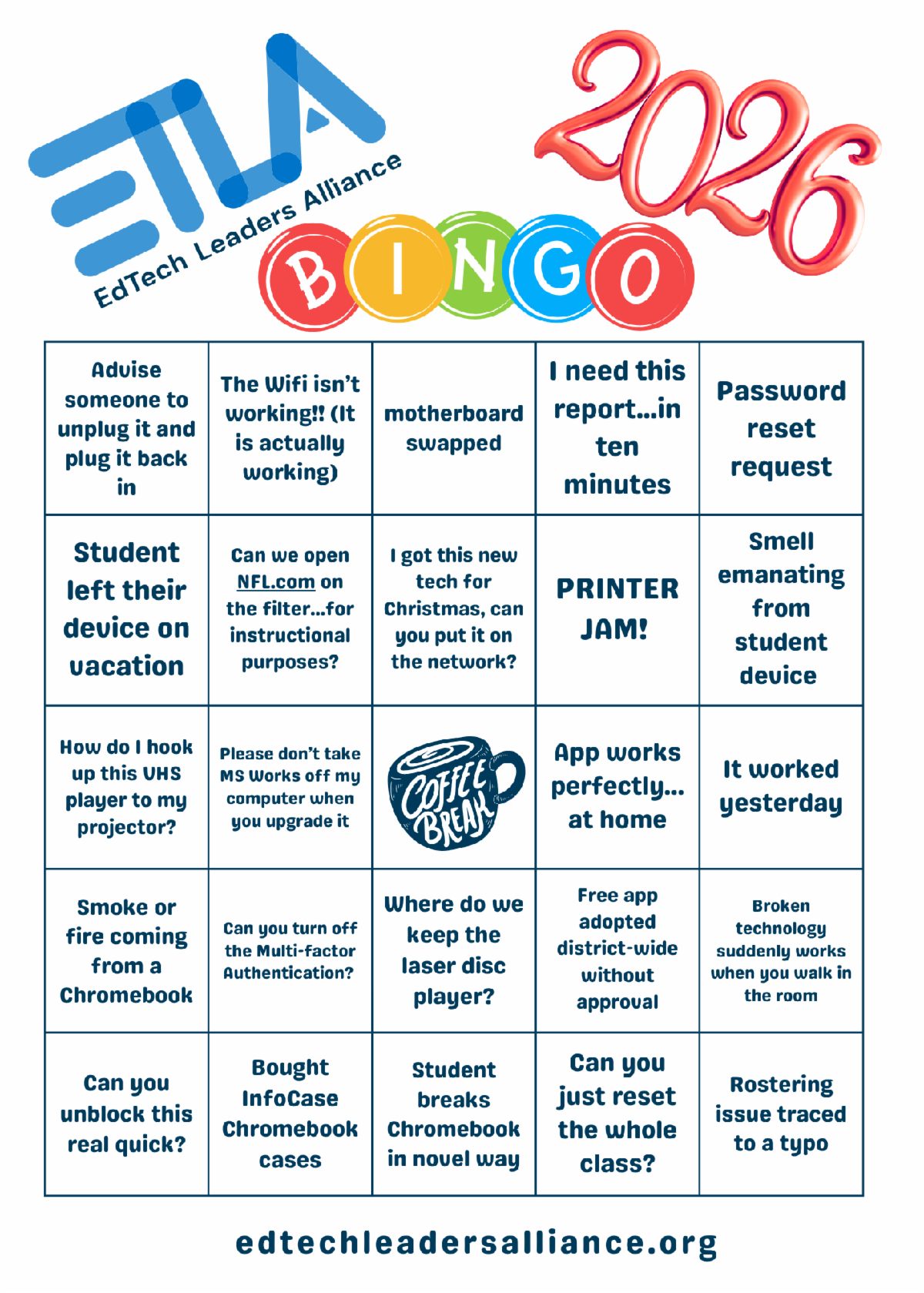
If there’s one constant in educational technology leadership, it’s that no two days look the same—and yet, somehow, many of the same moments show up year after year!
From the early-morning password reset request to the “Wi-Fi is down” report (when it definitely isn’t), tech directors juggle strategy, support, security, and emerging technologies, all while keeping students at the center of every decision. Add rapid AI adoption, evolving cybersecurity requirements, and persistent device challenges, and it’s clear that 2026 is shaping up to be another full bingo card kind of year.
That’s why we created the 2026 EdTech Leader Bingo Card: a lighthearted look at the moments that define a year in district technology leadership. Some squares may make you laugh, others may feel a little too real, and a few might prompt reflection on just how much the role continues to evolve.
Whether you’re checking off boxes already, using it as a conversation starter with your team, or simply enjoying the shared experience of the work, we hope this bingo card reminds you that you’re not alone in navigating the challenges and opportunities of modern EdTech leadership.
How many squares can you check off already? Download your own copy and play along this semester!
Big Ideas
That can’t be good.
As a former English teacher, I always look forward to the Merriam-Webster Dictionary’s word of the year. This year, the “honor” goes to the word “slop.” A nod to the flood of AI-generated content, this word reflects the perception that generative AI produces low quality products. More here. No word if ChatGPT has a rebuttal.
Major online training platform merger.
Banking on increased demand for AI training for employees, Coursera purchases rival Udemy for 2.5 billion. The deal calls for the two companies to combine their content, and serve post-secondary education, corporate, and independent customers. More details can be found here. The article notes that, overall, demand for online training and credentialing is lower than it was during Covid19.
The year end list you don’t want to be on.
While GenAI, data centers, and quantum computing got most of the buzz this year, this article reminds us that the cyber bad actors are still hard at work. Wired.com.com shares with us the biggest events of the year. Wishing you a safe and secure cyber new year!
Find us at FETC!
Carly Ghantous, Kevin Ghantous, and Stacy Hawthorne are excited to connect with educators and leaders at FETC 2026! Join us for meaningful conversations, practical insights, and opportunities to collaborate with K–12 leaders shaping the future of education.
Ohio Meet Up Hosted by ETLA
January 11, 2026 | 5:00–5:30 PM | W224F
Ohio attendees are invited to this State Network Alliance Social Meetup hosted by ETLA—an opportunity to connect with K–12 leaders from across Ohio to build lasting professional relationships.
State EdTech Trends 2025: Adapting and Innovating in a Digital World
January 13, 2026 | 9:30–10:15 aM | W414C
Dr. Stacy Hawthorne joins SETDA's Ji Soo Song and Julia Fallon, and Evo Popoff from Whiteboard Advisors for an in-depth exploration of the findings from the 2025 SETDA State EdTech Trends report. They will delve into how state education agencies and policymakers are shaping the future of K-12 EdTech, highlighting key state priorities in technology and education.
Leading Learning Today: Challenges and Opportunities
January 13, 2026 | 10:30–11:15 AM | W221 A&B
Dr. Stacy Hawthorne moderates a panel with Dr. Michael Nagler (Minneola Public Schools) and Glenn Robbins (Brigantine Public Schools) about strategies for leading through change amid shifting policies and funding, with insights into building resilient teams and preparing students for a future shaped by workforce pipelines and AI.
Policy Starts with People: How EdTech Leaders Shape National Conversations
January 13, 2026 | 1:00–1:45 PM | W414A
Dr. Stacy Hawthorne shares how EdTech leaders can influence policy at every level, offering practical tools to advocate effectively on issues like AI, cybersecurity, E-rate, and professional learning—starting right in your own community.