
When the Platform Goes Dark: A Teacher's Reckoning with the Canvas Hack
Picture this: your students are two hours into a high-stakes essay exam. The room — or in this case, the screen — is tense. They've been drafting, revising, maybe catastrophizing just a little. And then Canvas goes down.
Not "loading slowly" down. Not "try refreshing" down. Down down.
That's where I found myself in early May, in the middle of administering an online exam, when the ShinyHunters ransomware group decided to make Instructure, the company behind Canvas, their next headline. What followed was a scramble I'd rather not repeat, but also, honestly, one of the more clarifying professional experiences I've had in a while.
The short version of what happened: a criminal hacking group exploited a vulnerability in Canvas's Free-For-Teacher accounts to gain unauthorized access to data from roughly 9,000 institutions worldwide. They claimed to have stolen 275 million records (names, email addresses, student IDs, private messages) and threatened to release everything unless a ransom was paid. Canvas went into maintenance mode. Login pages were replaced with ransom notes. Instructure eventually paid up. The whole saga played out over about two weeks, right in the middle of finals season, and schools around the world scrambled to figure out what to do.
For my students in the middle of that exam, the immediate question wasn't geopolitical. It was: how do I submit this?
We figured it out. Emailed submissions, extended deadlines, a lot of "this is fine" energy from me that was only partially genuine. But the experience left me with a list of things I'm now doing differently. If you're a teacher who lives inside an LMS the way I do, you might want to think about these too.
Always have a backup submission plan.
Not a vague "we'll figure it out" plan. A real one, communicated to students before anything goes wrong. Now, on the first day of any major assessment, I will tell students: if Canvas is unavailable, submit to this email address, by this time, with this subject line. It takes two minutes to say and could save a lot of panic later. Think of it the way flight attendants think about emergency exits. You go over it hoping you'll never need it, but you go over it every time.
Export your course content. Now. Seriously.
This one hit me hardest. The moment Canvas came back online, I immediately exported all of my courses as Common Cartridge packages, the transferable format that lets you move content between platforms. I've been teaching and iterating on some of these courses for nearly a decade. That's ten years of carefully scaffolded assignments, rubrics, discussion prompts, and sequencing decisions that exist, right now, only inside a vendor's platform. When the platform is someone else's, your content is only as safe as their security posture. Export regularly, keep local copies, and treat your course content like the intellectual asset it is.
Communicate proactively when things go sideways.
One thing that made the Canvas disruption worse for students was the communication vacuum. Instructure was slow to go public. Their own CEO later acknowledged they'd gotten the balance wrong between "getting the facts right" and actually telling people what was happening. That's a useful reminder at the classroom level too. When something breaks, students' anxiety fills the silence immediately. A quick "I know Canvas is down, here's what we're doing" message even before you have a full solution goes a long way.
Your LMS is infrastructure, not furniture.
I think most of us, myself included, have come to treat our learning management system the way we treat the desks in our classrooms: something you notice only when they disappear. The Canvas hack was a reminder that these platforms are complex, internet-connected systems with real security vulnerabilities, and that dependency on any single platform carries real risk. That's not a reason to panic or abandon Canvas; it's still a genuinely useful tool. But it is a reason to think more intentionally about what you'd do if it disappeared tomorrow.
Talk to your students about it.
This one is maybe the most underrated. Cybersecurity incidents aren't just IT problems, they're media literacy teachable moments. My students had questions: What is ransomware? What data did they actually take? Should I be worried? Taking fifteen minutes to walk through what happened, what was and wasn't compromised, and how to think critically about these events is the kind of real-world application that usually gets crowded out by the curriculum. The Canvas hack was legitimately weird and interesting. Use it.
The good news, such as it is: Canvas is back, Instructure paid the ransom and claims the stolen data has been destroyed, and my students turned in their essays (mostly on time, all things considered). No one's grade suffered. But I'm a different kind of online teacher now than I was on May 6th. I’m a little less trusting, a lot more prepared, and the owner of several very satisfying course export files sitting safely on my hard drive.
The platform will probably be fine. But "probably" is doing a lot of work in that sentence, and I'm not leaving my ten years of course design on the other side of it anymore.
Media Literacy Minute

AI Is Masking America’s “Post-Literate” Workforce
Roughly 130 million U.S. adults read below a sixth-grade level and AI may be quietly helping hide it. This Axios investigation finds that AI tools allow workers to complete tasks they may not fully understand, masking fundamental literacy gaps until someone asks them to exercise judgment or evaluate an output. Researchers call this “cognitive surrender,” and warn it creates a workforce that looks productive on the surface but fragile underneath. For educators, the takeaway is urgent: building genuine foundational literacy matters more than ever in an AI-saturated world.
Analyzing the AI Literacy Gap: Preparing the Next Generation for an Automated World
Code.org frames AI fluency that is grounded in computer science, as a core literacy in the same category as reading and math. This SiliconValley.com piece examines the widening AI literacy gap in K-12 education and argues that preparing students for an automated world means treating AI comprehension as foundational, not optional. For school and district leaders already thinking about AI policy, it’s a useful snapshot of where the field consensus is heading.
In the Digital World, Children Need Parents They Can Turn To
Only 35% of children aged 12-17 say their parents often help when something upsets them online. 74% say they know more about the internet than their parents do. This UNICEF piece, published during Global Parenting Month, calls for greater investment in media, digital, and AI literacy for children, caregivers, and schools alike. The takeaway for educators: schools cannot carry the digital literacy conversation alone, and when adults model curiosity instead of avoidance, children are more likely to reach out when things go wrong online.
When the Breach Comes: How Schools Can Be Ready
ETLA Privacy Team
A data breach is not a matter of if. For most school districts, it is a matter of when. The gap between those that weather an incident and those devastated by one almost always comes down to preparation.
Here is where to start.
Know What You Have
You cannot protect what you have not inventoried. Districts must maintain a current data map that includes information about which vendors hold student data, what data they hold, how it is secured, and what contractual obligations govern a breach.
Recent incidents have made one thing clear: the risk extends far beyond your own systems.Third party providers with access to student data must be inventoried and managed with the same rigor. Data minimization is not optional. Mitigating risk by limiting what vendors collect, process and retain will directly limit what can be exposed.
Put Contracts to Work
Data privacy agreements (DPAs) are not compliance paperwork. They are your legal lever when a breach does occur. FERPA places the legal burden of compliance on the educational institution, not the vendor.
A well-constructed DPA should require vendors to notify the district promptly upon discovery of an incident, prohibit data retention beyond contract termination, and mandate data destruction with documented confirmation. If your contracts do not require these things, renegotiate.
Build the Plan Before You Need It
To ensure effective and consistent incident response, the U.S. Department of Education, Privacy technical Assistance Center recommends that agencies should design and implement a comprehensive data breach response plan and keep it up-to-date through regular data threat assessments and awareness of changes in applicable law.
That plan should identify who contacts counsel, who notifies families, who engages the vendor, and who communicates with the board. It should include template notifications and be exercised through annual tabletop drills. A plan that lives in a drawer is not a plan.
Train Staff, Repeatedly
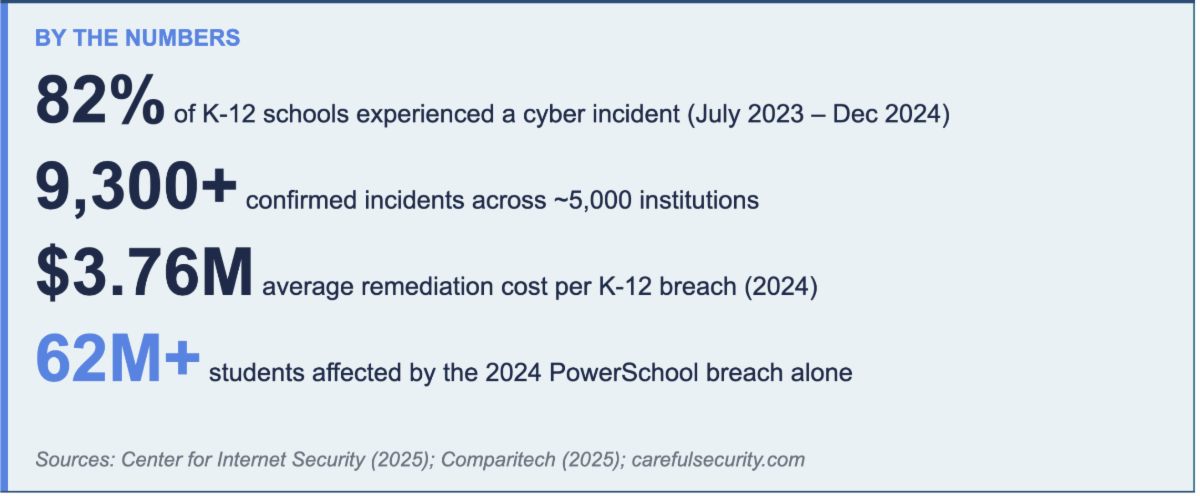
Human-targeted attacks like phishing and social engineering were the primary entry vector from July 2023 through December 2024, exceeding other techniques by roughly 45%. Over 90% of ransomware attacks on K-12 in 2024 were attributable to an exploited vulnerability, compromised credentials, or a malicious email.
Annual training is a floor, not a ceiling. Staff need reinforcement, simulated scenarios, and clear escalation paths when something looks wrong. As our environment changes, we must also evolve. Data protection is not just a compliance exercise, it is a core part of keeping students safe.
Understand Your Notification Obligations
FERPA itself contains no data breach notification requirement, it does not mandate notifying students, parents, or the Department of Education after a breach. However, most institutions are bound by state breach notification laws that apply to student data regardless of FERPA. State laws often impose specific timelines and content requirements on top of FERPA’s general guidance.
Know your state’s obligations before an incident, not during one. Waiting to figure out the law while families are asking questions is a failure of leadership.
Conduct Vendor Risk Reviews
Not all vendors carry equal risk. For example, the 2022 Illuminate Education incident affected over 3 million students while the 2024 PowerSchool breach affected 62 million, demonstrating how vendor vulnerabilities can expose massive amounts of student data even when vendors have made strong public cybersecurity commitments.
Tier vendors by the sensitivity of data they access and apply proportionate scrutiny. Make risk assessment a standard part of every procurement decision, not an afterthought.
Preparation does not prevent every breach. But it determines whether your district responds with confidence or scrambles in crisis. The work done before an incident is what protects students when one occurs.
ETLA is in Your Corner!
Student data protection is complex and your district should not have to navigate it alone. ETLA Data Privacy Services was built by former K-12 professionals who have been where you are. Our mission is straightforward: help you protect students and strengthen district operations before, during, and after an incident.
DPA Negotiations
Expertly negotiated Data Privacy Agreements that meet current standards and protect your district’s legal interest.
Vendor Risk Assessment
Structured review of edtech vendors by data sensitivity and risk tier. Know before they ever access the data.
Breach Monitoring & Member Alerts
Active monitoring of vendor incidents affecting K-12 districts, with timely alerts and guidance delivered directly to members.
District Training & Advisory Services
Practical K-12 focused training and resources for staff and leadership, plus direct access to privacy advisors who know your district’s landscape.
Are you ready to strengthen your district’s privacy posture? Contact us at privacyservices@edtechleadersalliance.org
This article is provided for informational purposes only. It does not constitute legal advice. Consult qualified legal counsel for guidance specific to your district’s obligations.
Big Ideas

Parrots aren't just mimicking — they may be using names
A PLOS One study of nearly 900 companion parrots found that close to half were reported to use human names, often in contextually appropriate ways rather than mindless mimicry. Some birds appeared to refer to someone who wasn't even present, while others said their own name to grab attention, and a few reportedly corrected humans who used the wrong name. Grey parrots were the standouts, but appropriate name use showed up across 30 species, putting parrots in the same club as elephants and dolphins.
Bumblebees solved a chimp puzzle with no training
In a study in Science, Finnish researchers gave bumblebees a version of the century-old "box-and-banana" insight test and watched them roll a foam ball under an out-of-reach flower, climb on it, and reach the reward spontaneously, with no training on the solution and no trial and error. Nearly 75% of the prepared bees cracked it, despite having brains the size of a sesame seed. One author's reaction: the bee "knew exactly what she was doing." It's the first time spontaneous problem-solving has been shown in any invertebrate.
Scientists are (seriously) asking if bees and ChatGPT are conscious
A wave of new work argues that consciousness can't be judged by behavior alone; whether the subject is a chatbot waxing philosophical or a bee hunting for nectar. It's a genuinely funny pairing on the surface, but it lands as a sharp discussion prompt: if behavior isn't enough, what is the test?