Hacking Is Human Nature
Human beings are here today because, at some point, one of our ancestors looked at a perfectly good lightning strike and thought, “I wonder if I can use that.”
And just like that, fire became less of a terrifying sky tantrum and more of a dinner plan.
The wheel? A hack. Agriculture? A hack. Written language? A hack for remembering things without relying on the person in the village with the best memory. The printing press hacked access to information. The internet hacked geography. Smartphones hacked the phrase, “I’ll have to look that up when I get home.” Generative AI and large language models are, in many ways, the latest chapter in humanity’s long tradition of asking, “Can this be done faster, differently, or with slightly less suffering?”
We are, as a species, workaround machines.
Which brings us, naturally, to the eighth grader who has found a way around the school’s content filter.
To be clear, this is not an endorsement. Schools have a responsibility to keep students safe online. Filters, blocks, monitoring systems, cybersecurity practices, acceptable and responsible use policies, and thoughtful guardrails all exist for good reasons. Students do not have an unlimited right to do whatever they want on school networks or devices. When they violate policy, access inappropriate content, bypass safeguards, or create risk for themselves and others, there should be consequences.
But we may understand the behavior more clearly if we stop acting shocked by it.
Students finding workarounds is not a new problem created by technology. It is a very old human instinct wearing a hoodie and holding a Chromebook.
Before students were bypassing filters, they were passing notes, hiding comic books inside textbooks, writing answers on their hands, sneaking calculators into non-calculator tests, and discovering which hallway stairwell had the least adult supervision. The tools have changed. The impulse has not.
Young people are curious. They test boundaries and look for loopholes. They want autonomy. They want to know what happens when they press the button labeled “Do Not Press.” Honestly, adults do too. We just call it “innovation” when we do it in a conference room.
On one hand, we cannot shrug and say, “Well, hacking is human nature, so good luck out there.” Digital environments create real risks: harmful content, privacy concerns, cyberbullying, malware, academic dishonesty, and unsafe interactions. Schools are right to put protections in place.
On the other hand, if our only response to student workarounds is to ban the device, block more sites, tighten every setting, and treat curiosity as misconduct, we miss an opportunity. Worse, we may teach students that technical skill is something to hide rather than something to develop ethically.
What if we asked, “How do we help students understand when a workaround is clever, when it is harmful, and when it crosses an ethical line?”
A student who bypasses a filter to access a game during class is making a poor choice. A student who bypasses a filter to access explicit or dangerous content is creating a safety concern. A student who discovers a security weakness and exploits it has crossed a serious line. But a student who notices that a system does not work as intended, asks why, and wonders how it could be improved may be demonstrating the exact kind of thinking we say we want: problem-solving, persistence, systems thinking, creativity, and technical fluency.
The difference is not the instinct. The difference is the ethics, context, and impact.
Students should learn that digital citizenship is not just about being nice online. It is also about power. When you know how to get around a system, you have power. When you have power, you have responsibility. The question is not just, “Can I do this?” It is, “Should I do this? Who could be harmed? What rule or trust am I breaking? Is there a better way to solve the problem?”
This is where consequences and opportunities can work together.
When students misuse technology, schools should respond appropriately and consistently. But we should also look for ways to redirect that energy. Cybersecurity clubs, student tech teams, capture-the-flag competitions, responsible disclosure processes, coding projects, AI literacy lessons, and conversations about ethical hacking can turn “How did you get around that?” into “How can you use that skill for good?”
The truth is we need ethical hackers. We need people who can find vulnerabilities before bad actors do. We need creative problem-solvers who question systems, test assumptions, and improve what exists. We need students who know how technology works, not just students who know how to comply with it.
The goal is not to eliminate the hacking instinct. We could not do that if we tried. The goal is to civilize it.
After all, the same human impulse that led someone to roll a heavy object on a log eventually led us to wheels, engines, airplanes, satellites, and spacecraft. The same impulse that leads a student to wonder whether a filter can be bypassed might one day lead that student to secure a hospital network, design safer software, or protect a school district from ransomware.
So yes, keep the filters. Enforce the rules. Protect students. Hold individuals accountable when they make poor choices.
But do not confuse curiosity with corruption.
Hacking is human nature. Our job as educators is not to pretend students will never look for the workaround. Our job is to help them understand which workarounds make the world better, which ones put people at risk, and how to use their very human instinct to build rather than break.
Media Literacy Minute
Unpacking the Role of AI Literacy in Cognitive Outcomes and Creative Self-Efficacy
A new peer-reviewed study finds that students’ AI literacy is directly linked to stronger academic motivation, better learning outcomes, and heightened creative self-efficacy — suggesting institutional investment in AI literacy programs pays dividends well beyond technical skills. This Nature study gives educators compelling, research-backed evidence for weaving AI literacy into K-12 instruction rather than treating it as an optional add-on.
7 Insights About AI from an Award-Winning Technology Teacher
An award-winning technology teacher shares what she’s learned integrating AI into the classroom—from building student empathy through hands-on AI experiences to keeping the focus on critical thinking over convenience. This Discovery Education piece distills seven practical takeaways educators can use to teach with and about AI in meaningful, literacy-centered ways.
Poynter’s MediaWise to Expand Youth Media Literacy Education with $750,000 Grant
Poynter’s MediaWise program has secured a $750,000 grant from the Andrew Carnegie Foundation to scale up its youth-focused media literacy curriculum, adding new video content and classroom resources that help students recognize misinformation. This Poynter announcement details how the investment will reach underserved students and expand tools for educators and parents.
The $10 Problem: What Screen Time Scarcity Teaches Us About EdTech Quality
Imagine you have unlimited money. Spending $5 on an ice cream cone at Whippy Dip is an easy yes — it's pleasant, low-stakes, effortless. Now imagine you only have $10. Suddenly that same $5 needs to work a lot harder. You start asking: Is this the best use of what I have? What does this actually do for me?
That's the question Los Angeles Unified School District just forced every educator in the country to sit with. LAUSD recently announced it will ban screens for students below second grade in what is the latest in a growing wave of tech backlash sweeping K–12. The instinct behind the policy is understandable. But banning screens by the clock doesn't solve the actual problem. It just creates a smaller window.
And here's the thing about constraints: they have a way of making us more intentional.
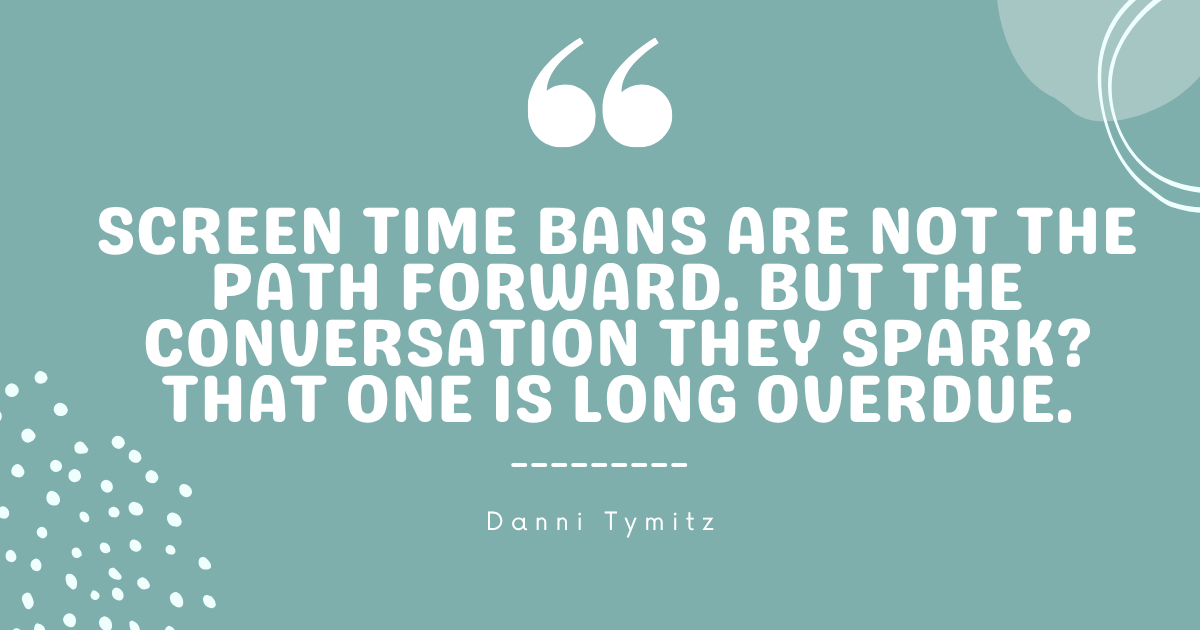
Let me be direct: screen time bans are not the path forward. But the conversation they spark? That one is long overdue.
Time doesn't tell the whole story
A student who spends 45 minutes playing Cookie Clicker and a student who spends 45 minutes designing a video game using logic, creativity, and iteration are both "on screens." The timer tells you nothing about what's actually happening, specifically what cognitive demand is being placed on the learner, what skills are being practiced, or what thinking is being required.
This is why screen time monitoring, while well-intentioned, is also incomplete. A single metric can't capture quality. Scrolling social media and facilitating a peer discussion in a shared document look identical on a timer. They are not the same experience for a learner.
I've written before about the Screen Time Continuum, a framework that maps screen-based activities across SAMR, Webb's Depth of Knowledge, and Bloom's Taxonomy. The point isn't to rank activities as "good" or "bad." It's to make visible what's actually happening when a student engages with a screen: Are they recalling, or are they creating? Consuming, or producing? Clicking, or thinking?
Back to the $10 problem. When screen time is constrained — whether by policy, by schedule, or by intentional design — it becomes a limited resource. And limited resources force better questions.
If a teacher only has 30 minutes of screen time to use with students this week, they're going to think carefully about where it goes. Does this tool genuinely support the learning goal, or is it just a digital version of a worksheet? Does this activity invite students to create something, or just absorb something? Is this the highest-value use of this moment?
Those are good questions. Those are the questions we should be asking whether or not a ban is in place.
The real gap is professional learning
Here's where I want to be clear: the answer to low-quality screen time isn't less screen time. It's better-equipped educators.
Knowing how to evaluate an edtech tool, not just against curriculum standards, but against the interpersonal and cognitive skills students need beyond their K–12 career, is a sophisticated professional skill. It requires understanding how tools support or undermine deeper learning. It requires being a critical consumer of technology, not just a user of it. And it requires ongoing, structured professional learning to develop.
That's the conversation the LAUSD ban should be opening up: not how do we limit screens, but how do we build the professional capacity of educators to make screens matter in all districts, schools and classrooms?
For school leaders, that means asking hard questions about the professional learning culture in your buildings. For instructional coaches, it means having the frameworks and language to help teachers evaluate tools with intention. For classroom teachers, it means approaching edtech with the same rigor you bring to any other instructional decision.
Questions worth sitting with
- Are screens in your school being used for tasks that genuinely benefit from them?
- Are students spending more time creating than consuming?
- Do your teachers have the frameworks and support to evaluate edtech tools critically?
- What professional learning would shift the quality — not just the quantity — of screen use?
The goal isn't less screen time or more screen time. It's screen time that earns its place: chosen intentionally, designed thoughtfully, and aligned to the kind of learning that prepares students for a future we can't fully predict yet.
That's a worthy investment of any budget.
Big Ideas
Two stories this season, two different answers to the same question — what schools owe students in the AI era, and what they should be protected from.
Boston bets that "AI fluency" is a graduation-grade skill. Starting this September, Boston aims to become the first major U.S. city to ensure that all high school graduates are proficient in artificial intelligence, seeded by a $1 million grant from Kayak co-founder (and BPS alum) Paul English. The curriculum, built with UMass Boston and pitched as ethical and critical engagement with AI rather than passive use, trains one teacher per high school this summer. Notably, the city walked back early "graduation requirement" headlines: the goal is proficiency, not a new diploma hurdle. The question remains: is fluency in a tool that rewrites itself every six months a durable skill, or are we teaching students to ride a bike that keeps turning into a different vehicle?
California bets that student data deserves a legal moat. Meanwhile, AB 1159 (Asm. Dawn Addis) would bar EdTech vendors from using student data to train generative AI, extend privacy protections up into higher ed, and give students the right to sue over violations. It's one of 134 AI-education bills across 31 states this session, and it converts the voluntary "we won't train on your data" pledges that Anthropic, Google, Microsoft, and OpenAI already make into an actual legal requirement. This is a real-time civics case study: what's the difference between a company promising not to do something and a law forbidding it?
The throughline: Boston is defining what counts as a skill worth teaching; California is defining what counts as data worth protecting. Put a teenager between them and you've got the whole education-and-AI debate in miniature: empowerment on one side, guardrails on the other, and not much consensus on where one ends and the other begins.