
The Price of Free: Ethics and EdTech Vendor Perks
Conference season comes with certain rituals: the badge, the tote bag, the crowded exhibit hall, and the invitations.
There may be a private dinner at an expensive restaurant, an evening cruise, a theme park experience, a sporting event, or a reception in a luxury suite. Some companies offer to cover conference registration, airfare, or lodging for valued customers, advisory-board members, or industry “influencers.”
These opportunities can feel like harmless relationship-building. Often, they are offered by good people who sincerely want to thank customers or create meaningful connections. But for public educators, the situation is more complicated.
Many educators and administrators hold professional licenses and serve under state laws, district policies, and codes of ethics. Those rules do not apply only to envelopes of cash. Depending on the jurisdiction, a gift can include meals, entertainment, tickets, travel, lodging, discounts, services, and other benefits.
The rules also vary significantly. Ohio, for example, prohibits public officials and employees from accepting substantial things of value from vendors, contractors, bidders, and others connected to their public work. Ohio Ethics Commission guidance specifically identifies travel and lavish meals as potential gifts and has addressed vendor-funded travel, meals, and lodging involving school employees.
New York illustrates why educators must understand the rules that apply specifically to them. Its General Municipal Law prohibits municipal employees from accepting gifts valued at $75 or more when the circumstances suggest that the gift was intended—or could reasonably be expected—to influence official duties. School districts must also adopt their own codes of ethics, which may establish additional or stricter expectations.
In other words, there is no universal “safe” dollar amount.
The Question Is Not Whether You Can Be Bought
Most educators would never knowingly trade a purchasing decision for a dinner or theme park ticket. That is not really the concern.
Hospitality creates goodwill. The ethical question is whether accepting a benefit could influence a decision, create a sense of obligation, or give others a reasonable basis to question the educator’s impartiality.
The risk becomes greater when the experience is expensive, exclusive, recurring, includes a spouse or guest, or is offered specifically because someone is a “top customer” or influential voice. It deserves even more scrutiny when the recipient evaluates products, recommends vendors, participates in procurement, approves renewals, or publicly promotes the company.
Even when no decision is improperly influenced, the appearance of influence can damage public trust. Recent enforcement actions outside education demonstrate that free food, alcohol, privileges, and other vendor-provided benefits can become the subject of formal ethics investigations.
A Better Conference Gut Check
Before accepting a vendor invitation, educators should ask:
- What is the complete fair-market value of the experience, including meals, admission, travel, lodging, and benefits provided to guests?
- Is the event broadly available to conference attendees, or was I selected because of my role or influence?
- Does the company currently do business, or hope to do business, with my district?
- Could I affect a purchase, renewal, recommendation, testimonial, or policy involving this company?
- Would I feel comfortable disclosing the invitation to my superintendent, board of education, colleagues, and community?
- Has my district’s ethics, legal, or procurement officer approved it in writing?
When the answer is unclear, asking before accepting is far safer than explaining afterward.
At Learn21, we intentionally avoid building customer relationships around lavish outings or paying educators’ conference travel expenses. That is not a claim of moral superiority. It is an effort to avoid placing our partners and our own team in an uncomfortable gray area.
Strong vendor relationships are valuable. Educators need opportunities to learn from companies, provide product feedback, share implementation experiences, and build professional networks. But those relationships should rest on transparency, service, trust, and the quality of the work, not on who provides the best dinner or most memorable excursion.
Sometimes the most ethical response to an impressive invitation is also the simplest: “Thank you, but my responsibility to my district does not allow me to accept.” The event may be free. Protecting public trust is priceless.
Media Literacy Minute
ISTELive 26: Critical Thinking in an AI-Driven Information Ecosystem
The rise of AI is pushing schools beyond how to use AI tools toward building the critical skill of evaluating and verifying AI-generated information. This GovTech report from ISTELive 26 explores classroom strategies like lateral reading, the SIFT method, and hands-on verification practice to help students develop healthy skepticism as informed consumers of digital content.
AI Use in Schools Growing, but District Policies Haven't Caught Up
A new survey from the Center for Democracy & Technology found that 85 percent of teachers used AI in their classrooms last year, but only half received any training, and 70 percent worry students' AI use is preventing them from learning critical skills. This GovTech report maps the widening gap between AI adoption and policy, and includes voices from educators and advocates pushing schools to focus not just on how to use AI, but on understanding how it's built, who profits from it, and what it means for learning.
As AI in the Classroom grows, Teaching Critical Thinking is Essential
As AI tools become a fixture in K-12 classrooms worldwide, researchers are raising a concern that transcends any single country: students are beginning to treat AI outputs the same way they once treated the teacher — as unquestioned authority. This World Economic Forum piece draws on emerging classroom evidence to argue that the real skill schools need to build isn't AI fluency but instead, it's the habit of critically examining what AI produces, questioning its framing, and understanding that it reflects the biases of its training data.
The Real ISTELive Happens Between the Sessions
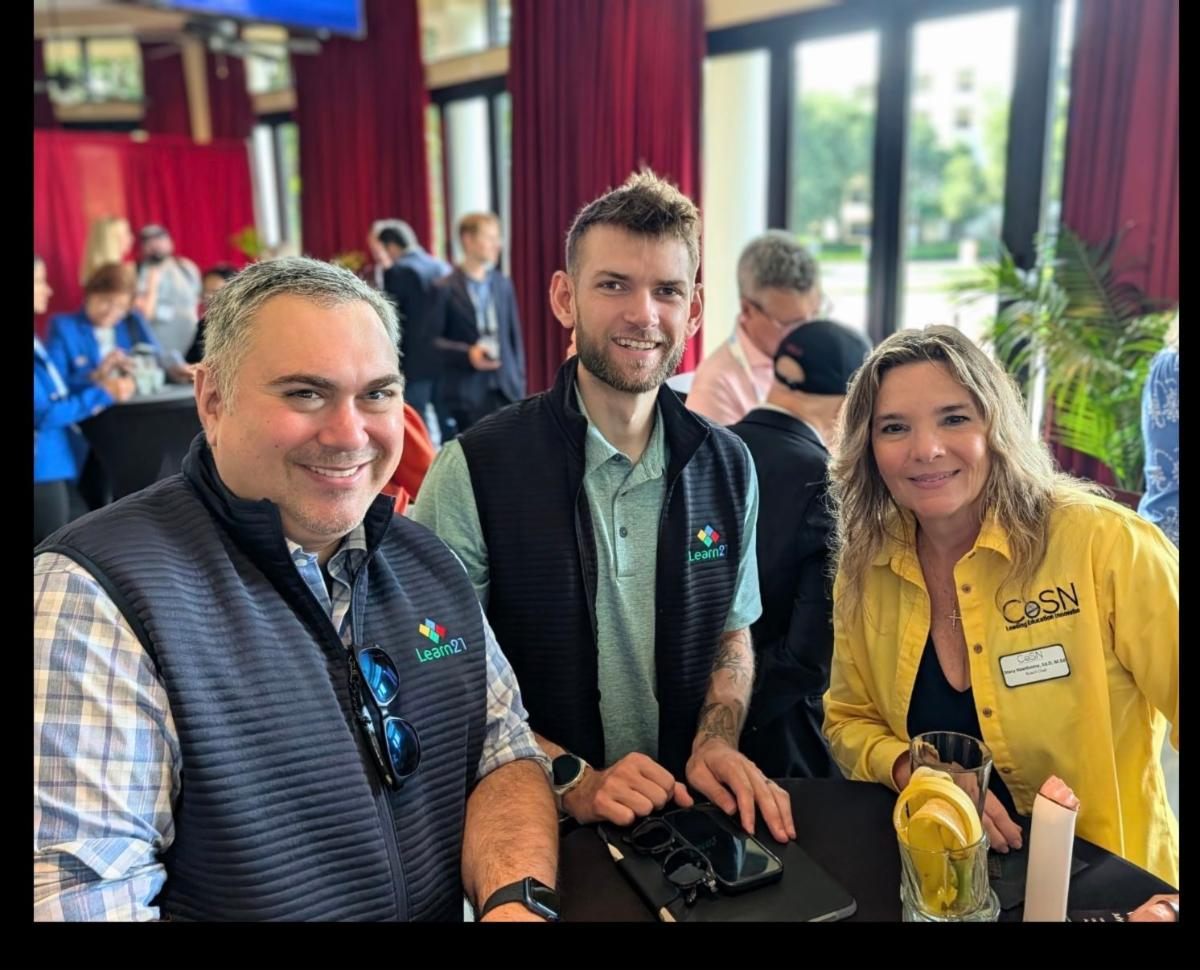
ISTELive 2026 publishes a packed agenda filled with keynotes, workshops, panels, and product demonstrations. Thousands of educators, leaders, researchers, nonprofit organizations, and technology companies gathered in one place to exchange ideas about the future of learning.
For many people the most valuable part of ISTELive was not found on the official schedule. It happened in the conversations.
Our ISTELive days were filled with meetings, some planned weeks in advance and others sparked by running into the right person at the right time. We connected with educators from across the country to hear what they are experiencing in their schools and districts. We spoke with leaders from other state alliances about the challenges their members are facing and the ways we might collaborate rather than reinventing the same solutions independently.
We also met with vendors interested in working more closely with educators to improve their products. Those conversations matter. The best educational technology is rarely created in isolation. It develops when companies listen carefully to the people who will use their tools and when educators have meaningful opportunities to shape solutions before decisions are finalized.
The conversations continued well beyond the conference center. Evening events, dinners, receptions, and informal gatherings gave us time to deepen relationships that are difficult to build through a quick email or a 30-minute video call. These moments may look social from the outside, but they often lead to future partnerships, shared resources, new ideas, and trusted professional networks.
That is the real power of bringing so many people who care deeply about education together in one place.
ISTELive can definitely feel overwhelming. It can be tempting to judge the value of the experience by how many sessions you attended or how many pages of notes you brought home. But the most important question may be simpler: Who did you meet, and what might you build together?
A single conversation with a district leader in another state can reveal that your organization is not alone in facing a particular challenge. A discussion with another association can uncover an opportunity to share expertise. An honest exchange with a vendor can help ensure that a future product is grounded in the realities of classrooms rather than assumptions about them.
None of this minimizes the value of formal professional learning. Sessions provide important information and inspiration. But information is now widely available, relationships are harder to replicate. The strongest professional networks are built through repeated interactions, shared experiences, candid conversations, and the discovery that someone else is trying to solve the same problem you are.
ISTELive 2026 reminded us that the conference itself is only the starting point. The real value comes from what happens afterward: the follow-up email, the introduction to a colleague, the collaborative project, the improved product, or the idea that finds its way back into a district.
The sessions may fill the agenda, but the people create the impact.
Big Ideas
This Week in Big Ideas: The World Cup's AI Technology Layer
Every Player is Now a Digital Twin
FIFA and Lenovo digitally scanned all 1,248 players at the 2026 World Cup, building millimeter-accurate 3D avatars used to power the tournament's offside calls. The models are so precise - right down to boot size - that Lenovo says they require secure distribution methods just to protect players' biometric privacy. It's a leap from the old generic-mannequin offside graphic to something that looks unmistakably like the actual human being.
Of course this begs the question: at what point does "player tracking for fairness" become "a biometric database of 1,248 bodies"? Who should own that data - the league, the players, or neither?
The Ball is Basically a Tiny Snitch
The official match ball, the Adidas Trionda, has a built-in motion sensor broadcasting its position hundreds of times per second straight into FIFA's officiating system. Paired with the player avatars, offside decisions that used to take minutes of squinting at slow-motion replays now resolve in seconds. Somewhere, a very small IoT device is having the busiest month of its short life.
Not Everyone's Cheering the Tech
The same AI infrastructure making officiating sharper is also being used for dynamic ticket pricing: costs that shift with demand, which critics say prices out fans already stretched thin by travel and lodging. FIFA's cheapest tickets were listed at $60, but by June 1 the actual cheapest opening-round tickets on FIFA's own marketplace ran $242–$960 — and one critic called the amount of lower-cost tickets "insultingly small." Meanwhile, spreading the tournament across three countries and 16 cities has turned it into what cybersecurity experts are calling a "multinational cybersecurity test," complete with fake FIFA websites, ticket scams, and phishing campaigns aimed at fans.