
TIME TO ACT!! The FCC Connected Care Pilot Program supports Cybersecurity Opportunity for Schools and Libraries
The FCC recently launched the Connected Care Pilot Program, a groundbreaking initiative designed to support schools and libraries in acquiring essential cybersecurity services and equipment. This pilot program is crucial for enhancing the digital security infrastructure in educational settings, ensuring that students and educators are protected in an increasingly digital world.
Why Cybersecurity Matters in K-12 Education
The need for robust cybersecurity measures in K-12 education cannot be overstated. According to the CoSN 2024 State of EdTech District Leadership Survey Report, cybersecurity is a top concern for school districts across the country. The report highlights that 95% of public schools rely on E-rate funding, making it the fourth largest source of non-state or local funding. As educational institutions become increasingly digital, protecting sensitive data and ensuring the integrity of online learning environments is more critical than ever.
The Importance of Applying
Even if schools and libraries are not selected in the first round, applying is still crucial. The number of applications will help the FCC gauge the demand for such funding, potentially influencing future funding decisions and allocations.
Key Details of the Connected Care Pilot Program
- Funding and Duration: The program is funded with $200 million over three years, sourced from the Universal Service Fund (USF).
- Application Window: The first round of applications is expected to open this fall. Schools and libraries are highly encouraged to apply as soon as the window opens to maximize their chances of securing funding.
- Eligible Services: The pilot program covers a broad range of cybersecurity services, including next-generation firewalls, endpoint protection, identity protection and authentication, and monitoring, detection, and response. It's important to note that equipment already eligible for E-rate funding is excluded from this pilot.
- Funding Caps and Prioritization: The program offers discounts similar to the E-rate program, with per-applicant pre-discount funding caps. Schools can receive up to $40.80 per student over three years, while libraries can receive $15,000 per year per location. All applicants must request a minimum of $15,000, with a maximum of $1.5 million. Funding commitments are prioritized based on the discount rate.
Call to Action
Schools and libraries should start preparing their applications now. Detailed plans, understanding deadlines, and selecting the best payment methods are essential steps to ensure a successful application. Additionally, preparing for audits and creating comprehensive business plans for purchases will help institutions spend their funds confidently and efficiently.
Resources
Acknowledgment
This article includes information from an ISTELive 2024 presentation, “Mastering E-rate and Ed Tech Policy” by Sheryl Abshire, Ph.D., John Harrington, and Reg Leichty. Their expertise and insights have been invaluable in understanding the intricacies of the FCC’s new pilot program and the importance of cybersecurity in education.
By participating in the Connected Care Pilot Program, schools and libraries can take a proactive step toward safeguarding their digital environments and ensuring the security and success of their educational missions. Don't miss this opportunity to enhance your institution's cybersecurity capabilities.
Empowering All Learners: Using Generative AI to Improve Accessibility in K-12 Education
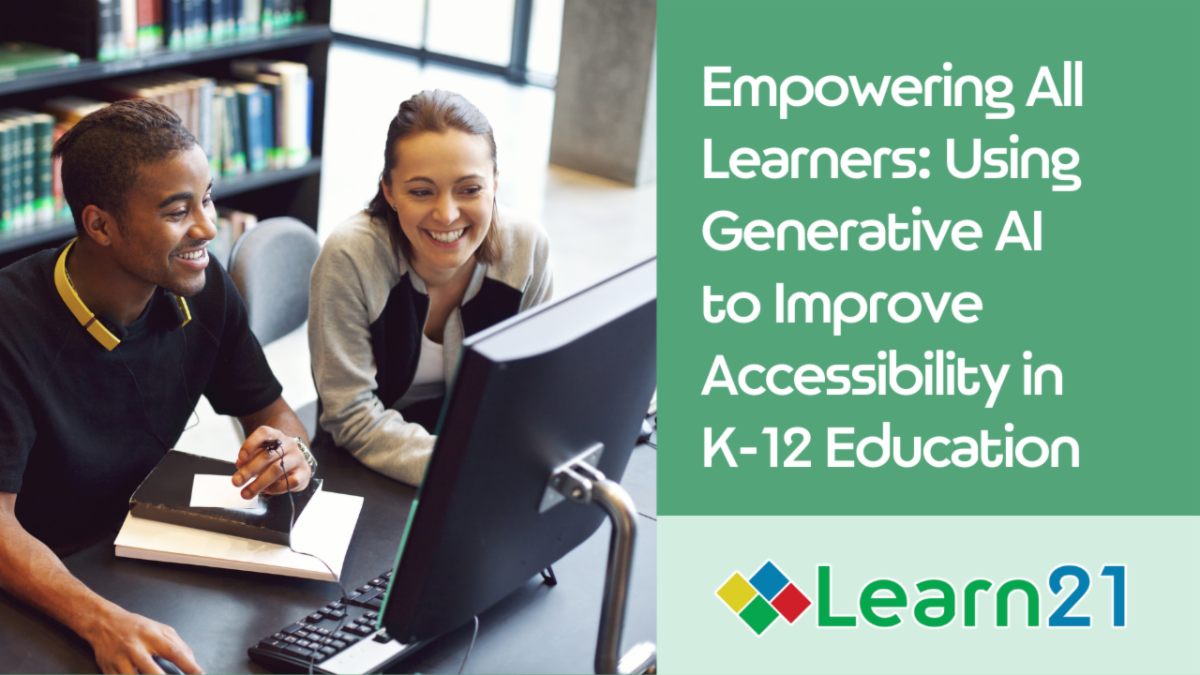
In today’s diverse classrooms, ensuring that all students have equal access to education is a paramount goal. With the rapid advancement of technology, generative AI is emerging as a powerful tool to enhance accessibility for K-12 students. This transformative technology can help create more inclusive learning environments, providing tailored support to meet the unique needs of each student. Let’s explore how generative AI can be leveraged to improve accessibility and ensure that every student has the opportunity to succeed.
Breaking Down Barriers: Personalized Learning Paths
One of the most significant ways generative AI can improve accessibility is through the creation of personalized learning paths. AI-driven platforms can analyze individual student data, such as learning styles, preferences, and areas of difficulty, to design customized educational experiences. This personalized approach ensures that students receive the right level of challenge and support, helping them to stay engaged and progress at their own pace.
Text-to-Speech and Speech-to-Text Technologies
Generative AI-powered text-to-speech (TTS) and speech-to-text (STT) technologies are invaluable tools for students with disabilities. TTS can help students with visual impairments or reading difficulties by converting written text into spoken words, making content more accessible. Conversely, STT technology can assist students with physical disabilities or those who struggle with writing by transcribing spoken words into text. These tools empower students to participate more fully in their education, regardless of their abilities.
Real-Time Translation and Language Support
In multilingual classrooms, language barriers can pose significant challenges to learning. Generative AI can bridge these gaps by providing real-time translation services. AI-powered translation tools can convert spoken or written content into different languages, enabling non-native speakers to understand and engage with the material. This capability not only supports language learners but also fosters a more inclusive classroom environment where all students can thrive.
Adaptive Assessment and Feedback
Generative AI can revolutionize the way assessments are conducted by making them more adaptive and responsive to individual student needs. Traditional assessments often fail to capture the full range of a student's abilities, especially those with learning disabilities. AI-driven assessment tools can adapt questions based on a student's responses, providing a more accurate measure of their knowledge and skills. Additionally, AI can offer instant, personalized feedback, helping students understand their strengths and areas for improvement.
Creating Inclusive Content
Generative AI can assist educators in creating more inclusive educational content. AI tools can help identify and eliminate biases in learning materials, ensuring that content is fair and representative of all students. AI can generate alternative formats for content, such as simplified versions or summaries, putting information into each student’s zone of proximal development.
Generative AI and Accessibility in Education: Key Insights
- Cornell University’s Center for Teaching Innovation: The rise of generative AI introduces new opportunities for making educational content more accessible. By leveraging AI technologies, educators can create more inclusive learning environments. For example, AI can generate alternative formats for content, such as audio versions of text or simplified summaries, which are beneficial for students with different learning needs. The Universal Design for Learning (UDL) framework can be integrated with AI tools to further enhance accessibility by accommodating diverse learners and eliminating unnecessary barriers in the learning process. Additionally, it's crucial to ensure that AI-generated content adheres to basic accessibility principles, such as including alt text for images and ensuring compatibility with assistive technologies like screen readers (Cornell Center for Teaching Innovation) (Cornell Center for Teaching Innovation).
- AT&T’s Accessibility Initiatives: AT&T highlights how AI technologies are used to support accessibility, particularly for individuals with disabilities. Their initiatives include developing AI-powered tools that provide real-time captioning and transcription services, which can greatly benefit students with hearing impairments. These tools convert spoken language into text, making classroom discussions and lectures more accessible. AI also assists in creating more accessible digital content by automatically generating descriptive audio for videos and images, enhancing the learning experience for visually impaired students. These advancements illustrate the potential of AI to break down barriers and promote inclusivity in educational settings (Cornell Teaching).
- Microsoft’s Accessibility Innovations: Microsoft is at the forefront of integrating AI into its suite of accessibility tools. Their AI-powered solutions include features like Seeing AI, which narrates the world around users who are blind or have low vision, and Translator, which provides real-time translation and transcription for students who are non-native speakers or have hearing impairments. These tools not only support students in accessing course materials but also enable them to participate more fully in classroom activities. Microsoft's commitment to using AI for accessibility demonstrates how technology can be harnessed to create more equitable educational environments (Cornell Center for Teaching Innovation).
- Forbes on Artificial General Intelligence and Accessibility: This article in Forbes discusses the broader implications of artificial general intelligence (AGI) for redefining accessibility. AGI, with its advanced capabilities, has the potential to revolutionize how we approach inclusivity in education. It can provide personalized learning experiences tailored to individual needs, from adaptive learning platforms that adjust to each student’s pace to intelligent tutoring systems that offer real-time, context-aware support. These advancements could significantly enhance the accessibility of education, ensuring that all students, regardless of their abilities or backgrounds, have the opportunity to succeed (Cornell Center for Teaching Innovation).
Embracing AI for a More Inclusive Future
Generative AI holds immense potential to transform K-12 education by making it more accessible and inclusive for all students. By leveraging AI technologies, educators can break down barriers to learning and ensure that every student has the support they need to succeed. As we continue to explore and implement AI in education, it is essential to remain mindful of ethical considerations and strive to create equitable learning environments. Together, we can harness the power of AI to empower all learners and build a brighter, more inclusive future for education.
Call to Action
Join the conversation on how AI can enhance accessibility in education! Follow Learn21 for more insights and resources, and share your thoughts and experiences with us. Connect with us on social media or reach out at engagements@learn21.org. Let's work together to create a more inclusive and supportive learning environment for all students.
Tips and Tricks
ChatGPT, one of the most popular AI chat bots, responds to prompts given by users to generate human-like text. For teachers, creating effective prompts involves being clear and specific about the desired outcome. For instance, instead of typing, "Tell me about history," a more focused prompt like, "Explain the causes and effects of the Industrial Revolution in England" yields better results. ChatGPT excels when given context in the prompts, so including background information helps it produce more relevant and accurate responses.
Additionally, posing open-ended questions encourages comprehensive answers. Guiding the AI to address particular aspects of a topic ensures the information provided aligns with the teacher's educational objectives. For example, asking, "How did the Industrial Revolution impact urbanization and labor conditions in England?" narrows the focus, helping ChatGPT to generate detailed and pertinent content.
Setting the role for ChatGPT can further enhance its effectiveness. By specifying the AI’s role, such as saying, "You are a history teacher," you provide it with a persona that guides its responses to be more tailored and relevant. This role-setting technique ensures that the AI's answers are aligned with the perspective and depth expected from a knowledgeable educator, thus enriching the learning experience for students.
The creator of ChatGPT, OpenAI, has a prompt engineering guide with more information. For Google Gemini users, Google also has prompt engineering guide available. To get the most out of the conversational AI, knowing how to talk to them will help you get better results. Remember to always validate any AI generated output for accuracy.
We also recommend checking out our AI in Education video series that details ways AI can change education. Check out our series on YouTube to learn more!
Extra Credit
When the going gets tough, memories get buff! A study by some New York University brainiacs found that putting in more cognitive effort (a.k.a. trying harder) really can pump up the power of your working memory. Just like how our muscles bulk up with more physical effort, our brains get better at storing info when we mentally flex those neurons. The subheading is great, The difficulty is what makes things great.
Games have been charming us since ancient times, and now they've stealthily taken over everything from online dating to social media and even stock markets. We've moved way beyond tic-tac-toe, today game design influences how we swipe right, scroll through feeds, and invest our hard-earned cash. By using scoring systems and rewards, game designers can guide our behaviors without us even realizing it, making us all unknowing participants in their grand design.
Researchers from ETS (the organizations that administers the SAT) tested GPT-4o grading on over 13,000 student essays and found it biased against Asian American students, deducting more points compared to human graders. The AI, unknowingly, served lower scores to Asian Americans. They couldn't figure out why this AI was harsher. Keep this in mind when AI is assessing student work.
Schools Give Students a Career Head Start with Help Desk Opportunities. EdTech Focus on K-12 highlights how student-run help desks in K–12 schools offer students valuable tech experience while addressing the IT talent shortage. Programs like those at Bethlehem Central School District and Ulster BOCES provide hands-on learning, college credits, and certifications, preparing students for tech careers and higher education.
These initiatives save on labor costs and ensure timely device repairs. The Learn21 Tech Director Toolbox is an excellent resource for supporting student helpdesks by offering tools and knowledge that enhance the efficiency and effectiveness of these programs, ensuring students receive practical and impactful learning experiences.
Register for ETLA Conference
Early Bird Pricing ends August 20th!
🙋♂️ Bytes and Insights is co-authored by Eduk8me’s Ryan Collins who writes about education and educational technology. He is also the Director of Technology for Kenton City Schools in Ohio. Sign up for his Of Bits and Bytes newsletter at https://eduk8.me!